
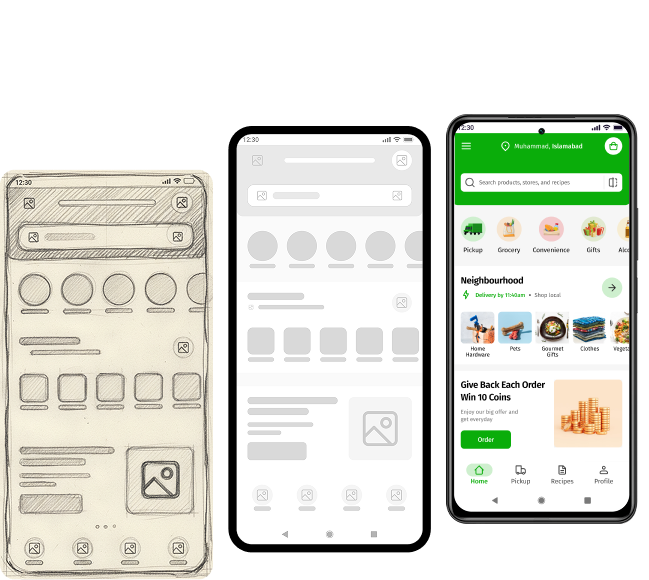
Every design engagement starts with structured discovery, stakeholder workshops, user interviews, competitive analysis, and behavioral research to map the full product context. We build user personas, define user journey maps, and identify usability friction points before a single frame is designed. This research foundation means every design decision is grounded in behavioral evidence, reducing product risk, lowering the cost of late-stage redesigns, and aligning the interface with how your target users actually think and act.
We design component-based UI systems in Figma, building modular, reusable component libraries with defined design tokens, consistent typography scales, and responsive grid structures that work across web, mobile, and SaaS platforms. Every component is documented for developer handoff, WCAG accessibility-compliant, and architected to scale with your product roadmap, so your design system grows with your team instead of breaking under it.
Design doesn't end at delivery. We run structured usability testing sessions, analyze interaction patterns, track task completion rates, and validate design decisions against real user behavior. Using heuristic evaluation and A/B testing frameworks, we identify and eliminate interface friction that quietly kills conversion rates, increases churn, and degrades user satisfaction, then implement targeted improvements validated against Nielsen's 10 usability principles, moving activation rate, task completion, and user retention in a measurable direction.

Every insight is documented and tied to a specific design decision. Tools used: Hotjar for behavioral heatmaps, Maze for task-flow testing, and structured user interview frameworks that produce persona data and journey map inputs, not assumption-based wireframes.

We map and structure your product's full content hierarchy, navigation logic, and interaction flows using proven IA frameworks, card sorting, tree testing, and user flow diagramming. Clear information architecture reduces cognitive load, shortens time-to-task, and directly improves completion rates across SaaS dashboards, mobile apps, and enterprise platforms.

We map and structure your product's full content hierarchy, navigation logic, and interaction flows using proven IA frameworks, card sorting, tree testing, and user flow diagramming. Clear information architecture reduces cognitive load, shortens time-to-task, and directly improves completion rates across SaaS dashboards, mobile apps, and enterprise platforms.

We build production-ready design systems in Figma, complete with reusable component libraries, defined design tokens, typography scales, color systems, and interaction states. Every component is documented for developer handoff, maintaining visual consistency across every product surface and reducing the design-to-development cycle on future features because engineers reference a documented component system rather than interpreting each screen from scratch.
Conversion-Focused Interface Design We design onboarding flows, dashboard layouts, and key interaction touchpoints with conversion strategy at the core, using psychological design principles, progressive disclosure, and friction-mapping to guide users toward activation, retention, and revenue-generating actions. Every interface decision is tied to a measurable product metric, not just aesthetic preference.

We run moderated and unmoderated usability testing sessions, analyze task completion rates, identify drop-off patterns, and conduct heuristic evaluations against Nielsen's 10 usability principles. Findings translate directly into prioritized design improvements, creating a continuous optimization loop that keeps your product experience sharp as your user base and feature set grow.
We start every engagement with structured product discovery, conducting user interviews, behavioral research, competitor audits, and jobs-to-be-done analysis to build a strategic design foundation. We define user personas, map end-to-end journey flows, establish information architecture, and validate core assumptions before any interface work begins,so every design decision has a documented behavioral or strategic basis not an internal assumption.


We design UX/UI systems for SaaS platforms and web applications, focusing on complex dashboard layouts, multi-step workflows, role-based interface structures, and data-heavy screen design. Our process combines information architecture, interaction design, and usability testing to produce interfaces that reduce cognitive load, improve feature adoption, and increase user retention across your core product flows.
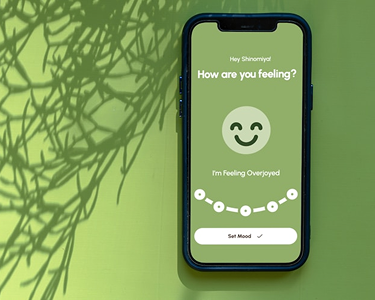
We design native and cross-platform mobile app interfaces, following iOS Human Interface Guidelines and Android Material Design principles to ensure platform-appropriate interaction patterns, gesture navigation, and visual hierarchy. Every mobile design is prototyped in Figma with realistic interaction flows, tested for usability across device sizes, and delivered with developer-ready specs for both React Native and native app development.
We design interfaces for AI-powered products and data-intensive platforms, where the challenge isn’t just aesthetics but making complex outputs, dynamic data, and machine-generated content legible, trustworthy, and actionable for real users. We apply progressive disclosure, data visualization principles, and explainable AI interface patterns to ensure your users understand and trust what the AI is showing them, which reduces user confusion, increases trust in AI-generated outputs, and keeps users engaged with features they might otherwise ignore or abandon.
We build production-ready design systems in Figma, complete with atomic component libraries, defined design tokens, typography scales, color systems, spacing frameworks, and documented interaction states. Every component is built for developer handoff via Figma’s Dev Mode, giving your engineering team a pixel-accurate implementation reference, maintaining visual consistency across every product surface, and providing a design foundation that scales with your feature roadmap without requiring a rebuild of the component system.
We audit existing digital products using heuristic evaluation against Nielsen’s 10 usability principles, session recording analysis, funnel drop-off mapping, and A/B testing frameworks, identifying the exact interface friction points that are costing you activations, conversions, and retention. We then design and validate targeted improvements with real users before implementation, ensuring every change is evidence-backed and measurably improves your core product metrics.
We conduct stakeholder interviews, product audits, technical constraint mapping, and competitive landscape analysis to build a complete picture of your product context. This phase defines the UX strategy, establishing design principles, success metrics, and a prioritized problem statement that every subsequent design decision is measured against. No wireframe is touched until the strategy is locked.
We define research-backed user personas based on real behavioral data, segmenting your audience by goals, motivations, technical proficiency, and key pain points. We then map end-to-end user journey flows for each persona, identifying every friction point, drop-off risk, and opportunity for engagement improvement across the full product experience. These artifacts become the strategic reference for every design decision that follows.
We design the full information architecture, structuring content hierarchy, navigation logic, and interaction flows using card sorting and tree testing methodologies. Low-fidelity wireframes are produced in Figma to establish layout logic, screen flow, and component placement before any visual design is applied. This phase ensures usability is validated structurally before a single color or typeface is introduced.
We build high-fidelity interactive prototypes in Figma, complete with realistic interaction flows, transition animations, and component states, that simulate the actual product experience without writing a line of code. Prototypes are tested with real users via Maze or moderated sessions to validate navigation logic, task completion flows, and interaction patterns before development investment is committed.
We design the full visual interface in Figma, applying brand identity, typography systems, color tokens, spacing frameworks, and iconography to produce polished, pixel-accurate high-fidelity screens. Simultaneously, we build the design system, atomic component library, variant states, responsive grid structures, and design tokens,so every UI element is reusable, consistently documented, and ready for developer implementation across all screen sizes and platforms.
We run structured usability testing sessions, moderated and unmoderated, using Maze and Hotjar to collect task completion data, identify navigation failures, and surface interface friction that was not visible during prototyping. Every usability issue is resolved before developer handoff begins.
We prepare complete developer handoff packages via Figma Dev Mode, including annotated component specs, interaction documentation, spacing and typography tokens, asset exports, and responsive behavior guidelines. We conduct design QA reviews during the development phase to verify implementation accuracy, catch visual regressions early, and verify that the built product matches the approved designs at the pixel level.
After launch, we monitor real user behavior through session recordings, funnel analytics, heatmaps, and engagement metric tracking, identifying where the live product diverges from expected user behavior. These insights feed a continuous UX optimization cycle, A/B testing interface variations, refining microcopy, adjusting interaction patterns, and iterating on conversion flows, so your product keeps improving as your user base grows and your feature set evolves.
We conduct stakeholder interviews, product audits, technical constraint mapping, and competitive landscape analysis to build a complete picture of your product context. This phase defines the UX strategy, establishing design principles, success metrics, and a prioritized problem statement that every subsequent design decision is measured against. No wireframe is touched until the strategy is locked.
We define research-backed user personas based on real behavioral data, segmenting your audience by goals, motivations, technical proficiency, and key pain points. We then map end-to-end user journey flows for each persona, identifying every friction point, drop-off risk, and opportunity for engagement improvement across the full product experience. These artifacts become the strategic reference for every design decision that follows.
We design the full information architecture, structuring content hierarchy, navigation logic, and interaction flows using card sorting and tree testing methodologies. Low-fidelity wireframes are produced in Figma to establish layout logic, screen flow, and component placement before any visual design is applied. This phase ensures usability is validated structurally before a single color or typeface is introduced.
We build high-fidelity interactive prototypes in Figma, complete with realistic interaction flows, transition animations, and component states, that simulate the actual product experience without writing a line of code. Prototypes are tested with real users via Maze or moderated sessions to validate navigation logic, task completion flows, and interaction patterns before development investment is committed.
We design the full visual interface in Figma, applying brand identity, typography systems, color tokens, spacing frameworks, and iconography to produce polished, pixel-accurate high-fidelity screens. Simultaneously, we build the design system, atomic component library, variant states, responsive grid structures, and design tokens,so every UI element is reusable, consistently documented, and ready for developer implementation across all screen sizes and platforms.
We run structured usability testing sessions, moderated and unmoderated, using Maze and Hotjar to collect task completion data, identify navigation failures, and surface interface friction that was not visible during prototyping. Every usability issue is resolved before developer handoff begins.
We prepare complete developer handoff packages via Figma Dev Mode, including annotated component specs, interaction documentation, spacing and typography tokens, asset exports, and responsive behavior guidelines. We conduct design QA reviews during the development phase to verify implementation accuracy, catch visual regressions early, and verify that the built product matches the approved designs at the pixel level.
After launch, we monitor real user behavior through session recordings, funnel analytics, heatmaps, and engagement metric tracking, identifying where the live product diverges from expected user behavior. These insights feed a continuous UX optimization cycle, A/B testing interface variations, refining microcopy, adjusting interaction patterns, and iterating on conversion flows, so your product keeps improving as your user base grows and your feature set evolves.
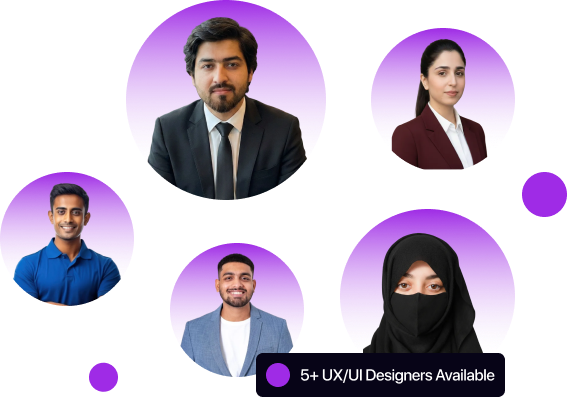
Skip the hiring process, get a senior Figma-native UX/UI designer embedded in your product team within days, not months. Whether you need one phase or the full eight, our design team slots in where your product roadmap requires.
Senior UX/UI designers available this week · Figma-native · Startup to enterprise experience


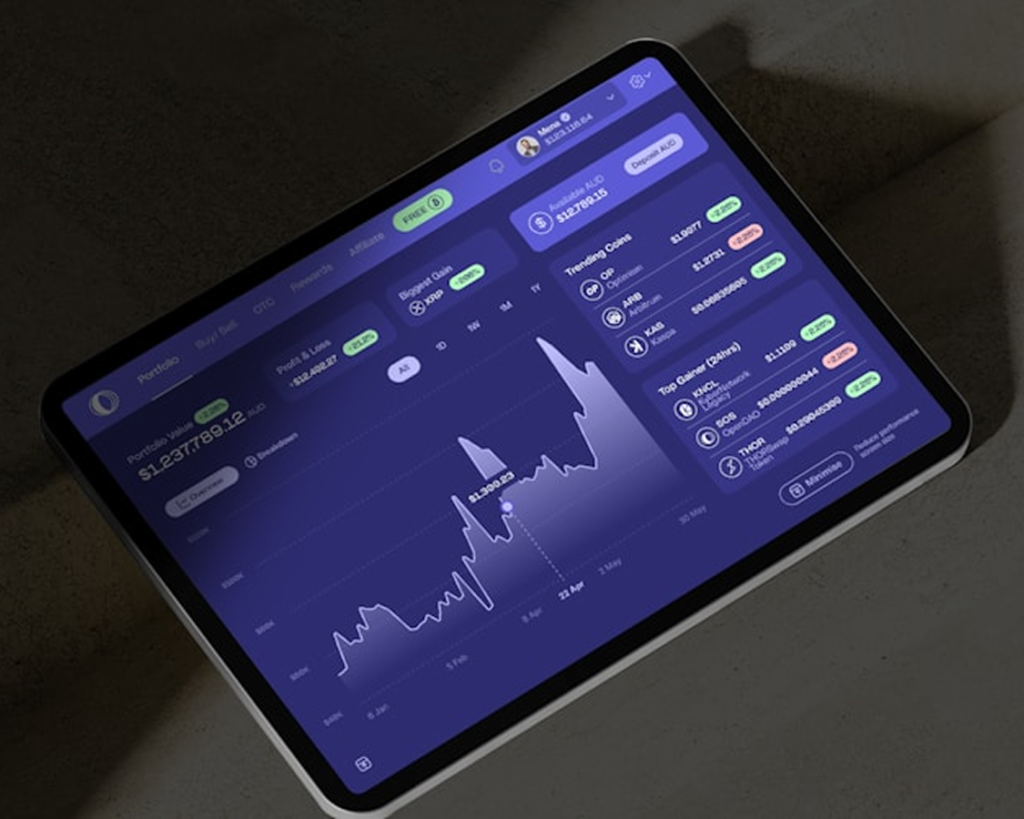
We develop secure finance software, trading platforms, investment apps, and automation tools designed to enhance financial operations, analytics, and digital transactions.
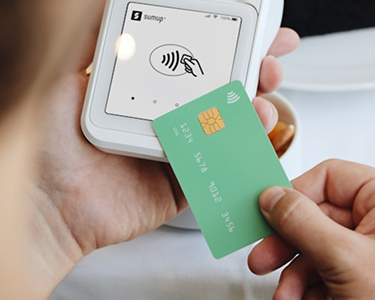

DentaSmart is a mobile app that uses AI and 3D tech to simplify dental care, from early diagnosis to personalized treatment.
DentaSmart is a mobile app that uses AI and 3D tech to simplify dental care, from early diagnosis to personalized treatment.
Amir Khan and his team is very responsible and works well. We have worked together and have been able to produce a good quality application. It has been easy to manage the project and they has delivered well. I would recommend others to use his services as they provide 100% perfect services.
Amir Khan and his team is very responsible and works well. We have worked together and have been able to produce a good quality application. It has been easy to manage the project and they has delivered well. I would recommend others to use his services as they provide 100% perfect services.
Amir Khan and his team is very responsible and works well. We have worked together and have been able to produce a good quality application. It has been easy to manage the project and they has delivered well. I would recommend others to use his services as they provide 100% perfect services.
There isn’t one fixed price because every project is different. The cost mostly depends on what you want to build and how complex it is. You can schedule a free consultation with our team to discuss your idea, explore options, and get a clear estimate based on your goals.
Depending on project scope, deliverables typically include: UX research findings and user personas, user journey maps and flow diagrams, information architecture documentation, low-fidelity wireframes, high-fidelity Figma designs for all screens and states, an interactive prototype, a component-based design system with design tokens, and a complete developer handoff package via Figma Dev Mode, including annotated specs, asset exports, responsive behavior documentation, and interaction guidelines. Every deliverable is structured for direct use by your development team without requiring additional design interpretation.
Every project goes through clear stages, research, design, development, testing, and review, so nothing feels rushed or uncertain.
Quality for us starts from how we plan, not just how we code.
Yes, absolutely.
We often work with clients who already have running systems or databases. Our team can analyze your current setup and build custom integrations using APIs or other secure methods to connect new features with your existing software.
Yes, absolutely.
We often work with clients who already have running systems or databases. Our team can analyze your current setup and build custom integrations using APIs or other secure methods to connect new features with your existing software.
Yes, absolutely.
We often work with clients who already have running systems or databases. Our team can analyze your current setup and build custom integrations using APIs or other secure methods to connect new features with your existing software.
No lengthy briefs. No commitment required. Just a free 30-minute design consultation, and a clear project scope delivered within 48 hours.
Senior Figma-native designers available this week · Startup to enterprise experience