We build healthcare software for clinics, hospitals, telehealth platforms, and health tech companies covering EHR and EMR systems, patient portals, telemedicine platforms, medical billing software, LIMS, and remote patient monitoring tools.
Every product is built to HIPAA and GDPR standards from the first sprint. Security architecture, audit logging, role-based access control, and interoperability standards are built into the system not added as a configuration layer after development is complete.
Below is the full range of healthcare software services and products we build.








We cover the full development lifecycle for healthcare software requirements gathering, system architecture, UI/UX design, development, compliance testing, and deployment. We build to HIPAA, GDPR, and HL7/FHIR standards from day one, not as a post-build checklist.
We deliver healthcare IT solutions, including ITSM implementation, legacy system modernisation, medical app development, and infrastructure support, with a focus on system reliability, security patching, and compatibility with existing clinical systems such as Epic, Cerner, and Meditech.
We integrate AI into healthcare software for clinical decision support, automated medical coding, predictive readmission alerts, diagnostic image analysis assistance, appointment-scheduling optimisation, and patient-communication automation, with all AI outputs presented as decision-support tools, not diagnostic replacements.
We build cloud-based healthcare platforms on AWS, Google Cloud, or Azure, with HIPAA-compliant data storage, end-to-end encryption, role-based access control, automated backups, and disaster recovery configurations. All cloud environments are validated for HITECH Act compliance and support Business Associate Agreement (BAA) requirements.
We integrate disparate healthcare systems using HL7, FHIR, and DICOM standards, connecting EHR/EMR platforms, laboratory systems, radiology, billing software, and patient portals into a unified data environment. We have integration experience with Epic, Cerner, Allscripts, and custom-built clinical systems.
We build healthcare analytics platforms covering clinical quality metrics, population health dashboards, operational KPIs, revenue cycle analytics, and regulatory reporting. Outputs are designed for clinical administrators and medical directors, giving them the data structure required for CMS quality reporting and Joint Commission compliance.
We cover the full development lifecycle for healthcare software requirements gathering, system architecture, UI/UX design, development, compliance testing, and deployment. We build to HIPAA, GDPR, and HL7/FHIR standards from day one, not as a post-build checklist.
We deliver healthcare IT solutions, including ITSM implementation, legacy system modernisation, medical app development, and infrastructure support, with a focus on system reliability, security patching, and compatibility with existing clinical systems such as Epic, Cerner, and Meditech.
We integrate AI into healthcare software for clinical decision support, automated medical coding, predictive readmission alerts, diagnostic image analysis assistance, appointment-scheduling optimisation, and patient-communication automation, with all AI outputs presented as decision-support tools, not diagnostic replacements.
We build cloud-based healthcare platforms on AWS, Google Cloud, or Azure, with HIPAA-compliant data storage, end-to-end encryption, role-based access control, automated backups, and disaster recovery configurations. All cloud environments are validated for HITECH Act compliance and support Business Associate Agreement (BAA) requirements.
We integrate disparate healthcare systems using HL7, FHIR, and DICOM standards, connecting EHR/EMR platforms, laboratory systems, radiology, billing software, and patient portals into a unified data environment. We have integration experience with Epic, Cerner, Allscripts, and custom-built clinical systems.
We build healthcare analytics platforms covering clinical quality metrics, population health dashboards, operational KPIs, revenue cycle analytics, and regulatory reporting. Outputs are designed for clinical administrators and medical directors, giving them the data structure required for CMS quality reporting and Joint Commission compliance.
Skip the hiring process and get a senior healthcare software engineer embedded in your project within days. Whether you are building an EHR integration, a patient portal, a telemedicine platform, or a medical billing system, we scope your requirements and deliver a compliance-ready development approach within two business days.
10+ healthcare software developers available now · HIPAA, GDPR & HL7/FHIR specialists · EHR, telemedicine & patient portal systems shipped to production





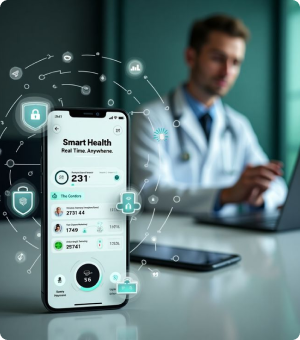








We build HIPAA and GDPR-compliant software with technical safeguards covering encryption at rest and in transit, audit logging, access controls, automatic session timeouts, and BAA execution with all cloud and third-party vendors. Compliance is built into the architecture from day one, not added as a configuration layer at the end.
We architect healthcare systems to scale from single-clinic deployments to multi-site hospital networks without requiring a rebuild, using cloud-native infrastructure, modular service design, and configuration-driven feature sets. When regulations change (as they do in healthcare), we update compliance configurations without disrupting the running system.
Our team includes developers with hands-on experience in clinical system integration, HL7/FHIR data exchange, HIPAA-compliant architecture, and medical device software development, built over projects across EHR vendors, telehealth platforms, and laboratory systems.
We design healthcare interfaces around the workflows of the people using them: clinicians working under time pressure, administrators managing high volumes, and patients navigating unfamiliar medical information. We run usability testing with representative users before release and measure adoption rates as a post-launch success metric.
We implement layered security across all healthcare products, AES-256 encryption at rest, TLS 1.3 in transit, multi-factor authentication, RBAC (role-based access control), intrusion detection, regular penetration testing, and OWASP Top 10 mitigation. Healthcare environments are high-value targets for ransomware; our security architecture is built around that specific threat model.
We integrate new healthcare software with existing clinical infrastructure, including EHR platforms (Epic, Cerner, Allscripts, Athenahealth), practice management systems, billing software, laboratory systems, and medical devices. Integration is handled through HL7 FHIR APIs, custom adapters, or direct database connectors, depending on what the existing system supports.
We provide post-launch support plans covering security patches (critical in healthcare, where vulnerabilities are exploited rapidly), regulatory compliance updates when HIPAA or GDPR rules change, performance monitoring, bug fixes, and feature additions. Support plans include defined SLAs and a dedicated technical contact.
We develop healthcare software in two-week sprints, delivering working, tested modules at the end of each sprint for your clinical and technical team to review. Sprint reviews include compliance checkpoints so regulatory requirements are validated continuously, not only at the end of development.
We build HIPAA and GDPR-compliant software with technical safeguards covering encryption at rest and in transit, audit logging, access controls, automatic session timeouts, and BAA execution with all cloud and third-party vendors. Compliance is built into the architecture from day one, not added as a configuration layer at the end.
We architect healthcare systems to scale from single-clinic deployments to multi-site hospital networks without requiring a rebuild, using cloud-native infrastructure, modular service design, and configuration-driven feature sets. When regulations change (as they do in healthcare), we update compliance configurations without disrupting the running system.
Our team includes developers with hands-on experience in clinical system integration, HL7/FHIR data exchange, HIPAA-compliant architecture, and medical device software development, built over projects across EHR vendors, telehealth platforms, and laboratory systems.
We design healthcare interfaces around the workflows of the people using them: clinicians working under time pressure, administrators managing high volumes, and patients navigating unfamiliar medical information. We run usability testing with representative users before release and measure adoption rates as a post-launch success metric.
We implement layered security across all healthcare products, AES-256 encryption at rest, TLS 1.3 in transit, multi-factor authentication, RBAC (role-based access control), intrusion detection, regular penetration testing, and OWASP Top 10 mitigation. Healthcare environments are high-value targets for ransomware; our security architecture is built around that specific threat model.
We integrate new healthcare software with existing clinical infrastructure, including EHR platforms (Epic, Cerner, Allscripts, Athenahealth), practice management systems, billing software, laboratory systems, and medical devices. Integration is handled through HL7 FHIR APIs, custom adapters, or direct database connectors, depending on what the existing system supports.
We provide post-launch support plans covering security patches (critical in healthcare, where vulnerabilities are exploited rapidly), regulatory compliance updates when HIPAA or GDPR rules change, performance monitoring, bug fixes, and feature additions. Support plans include defined SLAs and a dedicated technical contact.
We develop healthcare software in two-week sprints, delivering working, tested modules at the end of each sprint for your clinical and technical team to review. Sprint reviews include compliance checkpoints so regulatory requirements are validated continuously, not only at the end of development.
























We start with a discovery phase covering your clinical workflows, existing system landscape, compliance requirements (HIPAA, GDPR, state-specific regulations), user types, and integration dependencies. The output is a documented requirements specification and a compliance framework map, reviewed before any design or development begins.
We produce a development roadmap covering sprint schedule, technology stack selection, third-party integration plan, compliance milestone markers, and team structure. Risk assessment at this stage identifies regulatory dependencies (FDA, CE Mark, HIPAA technical safeguards) that affect timeline and architecture.
Our UX team designs clinical interfaces built for the conditions healthcare professionals work in, time pressure, high cognitive load, and frequent interruption. We produce annotated wireframes and interactive prototypes tested with representative users (clinicians, admins, or patients) before development begins. Healthcare-specific accessibility requirements (508 compliance, WCAG 2.1 AA) are addressed at this stage.
Development runs in two-week sprints with a compliance review integrated into each sprint's definition of done, meaning no feature is considered complete without security controls, audit logging, and data handling validation in place. API integrations with EHR systems, billing platforms, and medical devices are built and tested against real sandbox environments.
Every healthcare software build goes through functional, regression, load, security penetration, and accessibility testing. For clinical software, we also run clinical workflow validation testing, confirming the software supports real clinical processes without creating patient safety risks or workflow disruptions.
We deploy healthcare software with a phased rollout, starting with a controlled pilot group (a single department or user cohort), monitoring for issues, then expanding to full deployment. For regulated software, we produce deployment documentation required for compliance audit trails and, where applicable, FDA 510(k) or CE Mark technical file requirements.
Post-launch, we provide structured maintenance covering security vulnerability patching (healthcare is the most targeted sector for ransomware), regulatory compliance updates when HIPAA/GDPR rules change, performance monitoring, and feature development under defined SLAs. We provide quarterly compliance review reports for your IT governance team.
We start with a discovery phase covering your clinical workflows, existing system landscape, compliance requirements (HIPAA, GDPR, state-specific regulations), user types, and integration dependencies. The output is a documented requirements specification and a compliance framework map, reviewed before any design or development begins.
We produce a development roadmap covering sprint schedule, technology stack selection, third-party integration plan, compliance milestone markers, and team structure. Risk assessment at this stage identifies regulatory dependencies (FDA, CE Mark, HIPAA technical safeguards) that affect timeline and architecture.
Our UX team designs clinical interfaces built for the conditions healthcare professionals work in, time pressure, high cognitive load, and frequent interruption. We produce annotated wireframes and interactive prototypes tested with representative users (clinicians, admins, or patients) before development begins. Healthcare-specific accessibility requirements (508 compliance, WCAG 2.1 AA) are addressed at this stage.
Development runs in two-week sprints with a compliance review integrated into each sprint's definition of done, meaning no feature is considered complete without security controls, audit logging, and data handling validation in place. API integrations with EHR systems, billing platforms, and medical devices are built and tested against real sandbox environments.
Every healthcare software build goes through functional, regression, load, security penetration, and accessibility testing. For clinical software, we also run clinical workflow validation testing, confirming the software supports real clinical processes without creating patient safety risks or workflow disruptions.
We deploy healthcare software with a phased rollout, starting with a controlled pilot group (a single department or user cohort), monitoring for issues, then expanding to full deployment. For regulated software, we produce deployment documentation required for compliance audit trails and, where applicable, FDA 510(k) or CE Mark technical file requirements.
Post-launch, we provide structured maintenance covering security vulnerability patching (healthcare is the most targeted sector for ransomware), regulatory compliance updates when HIPAA/GDPR rules change, performance monitoring, and feature development under defined SLAs. We provide quarterly compliance review reports for your IT governance team.

Amir Khan and his team is very responsible and works well. We have worked together and have been able to produce a good quality application. It has been easy to manage the project and they has delivered well. I would recommend others to use his services as they provide 100% perfect services.
Amir Khan and his team is very responsible and works well. We have worked together and have been able to produce a good quality application. It has been easy to manage the project and they has delivered well. I would recommend others to use his services as they provide 100% perfect services.
Amir Khan and his team is very responsible and works well. We have worked together and have been able to produce a good quality application. It has been easy to manage the project and they has delivered well. I would recommend others to use his services as they provide 100% perfect services.
No generic proposals. No template-based scoping. Tell us your platform type, compliance requirements, existing systems to integrate, and target users and we will come back with an architectural approach, compliance framework, and cost breakdown within two business days.
Whether you are building a new clinical system from scratch or integrating with an existing EHR infrastructure, the conversation starts here.
10+ healthcare software developers available now · HIPAA, GDPR & HL7/FHIR specialists · EHR, telemedicine & patient portal systems shipped to production