
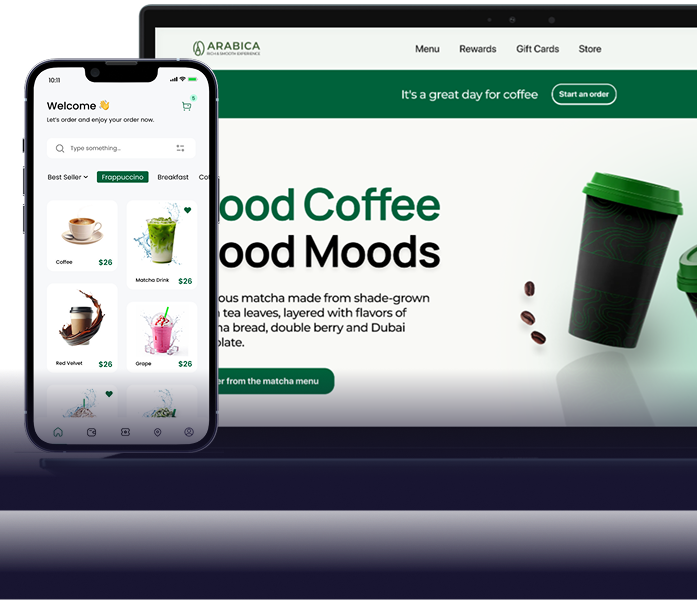


We design PWA interfaces optimized for the installable, app-like experience users expect from Progressive Web Apps,building responsive layouts that adapt fluidly from mobile to desktop, designing offline state UI that handles connectivity loss gracefully, and creating smooth navigation patterns that feel native despite running in the browser. Every PWA design is prototyped in Figma and validated against mobile usability standards before development begins,so the installed PWA experience matches or exceeds the native app experience on every device.
We build fully responsive Progressive Web App interfaces, implementing fluid CSS grid layouts, flexible image handling, viewport-adaptive typography, and touch-optimized interaction patterns that deliver consistent, high-quality experiences across smartphones, tablets, and desktop browsers. Our responsive PWA builds are tested across Chrome, Firefox, Safari, and Edge on iOS and Android,verifying layout integrity, touch target sizing, and interaction behavior against production standards on every device your users access the PWA from.
We audit and optimize existing Progressive Web Apps for maximum Lighthouse PWA score and Core Web Vitals performance, covering Service Worker cache strategy optimization with Workbox, JavaScript bundle splitting and lazy loading, image optimization and next-gen format delivery, critical rendering path optimization, Time to First Byte (TTFB) reduction, and Largest Contentful Paint (LCP) and Cumulative Layout Shift (CLS) improvements. Every optimization is measured against real user metrics and verified against Google’s PageSpeed Insights before and after implementation.
We integrate Progressive Web App capabilities into existing web applications, adding Service Worker offline support, Web App Manifest installability, push notification systems, and background sync to existing React, Angular, or Vue.js web apps without requiring a full rebuild. We also integrate PWA front-ends with existing backend systems via REST API and GraphQL, Firebase Firestore for real-time data synchronization, and third-party service integrations, extending your existing web investment with native app capabilities rather than replacing it.
We provide ongoing maintenance and support for live Progressive Web Apps, covering Service Worker update management, Workbox cache strategy refinement, push notification system health monitoring, browser compatibility updates as Chrome, Safari, and Firefox release new PWA API support, Lighthouse score monitoring, and Core Web Vitals performance tracking. We also manage Google Play TWA updates and iOS App Store WKWebView wrapper submissions for PWAs distributed through app stores, keeping your progressive web app compliant, performant, and current across every distribution channel.
PWAs are built on open web standards, Service Workers, Web App Manifest, and the Push API, that evolve with browser capabilities without requiring app store updates or user reinstallation. As browsers expand PWA API support, your application gains new capabilities automatically, making PWA architecture inherently future-proof compared to native apps locked to specific SDK versions.
Service Workers intercept network requests and serve cached responses when connectivity is unavailable, implemented via Workbox cache strategies including cache-first for static assets, network-first for dynamic content, and stale-while-revalidate for frequently updated resources. Users access your PWA's core functionality regardless of network conditions, eliminating the blank screens and error states that break native app experiences under poor connectivity.
PWAs use responsive CSS grid layouts, fluid typography, and viewport-adaptive component design to deliver consistent, high-quality experiences across smartphones, tablets, and desktops from a single codebase. Combined with touch-optimized interaction patterns and mobile-first performance budgets, PWA interfaces meet users on every device they use, without platform-specific UI divergence or separate mobile and desktop builds.
Workbox's intelligent caching strategies minimize network requests by serving cached assets for repeat visits, reducing bandwidth consumption, improving load performance on slow connections, and ensuring fast, reliable access even in low-signal mobile environments. Background Sync API queues user actions taken offline and synchronizes them automatically when connectivity resumes, preserving data integrity without requiring users to repeat actions.
The Push Notifications API enables PWAs to send timely, relevant notifications to users even when the browser is closed, delivered via Firebase Cloud Messaging for reliable cross-platform notification delivery. Push notifications drive re-engagement, reduce churn, and keep users informed about time-sensitive content updates, order status changes, and personalized triggers, matching the re-engagement capability of native apps without requiring App Store installation.
Web App Manifest configuration enables PWAs to be installed directly to the home screen on iOS and Android, launching in standalone mode without browser chrome, with a custom app icon, splash screen, and theme color that match your brand identity. Installed PWAs behave indistinguishably from native apps in the device's app drawer and task switcher, delivering the app-like experience users expect without the friction of App Store discovery and download
PWAs are built on open web standards, Service Workers, Web App Manifest, and the Push API, that evolve with browser capabilities without requiring app store updates or user reinstallation. As browsers expand PWA API support, your application gains new capabilities automatically, making PWA architecture inherently future-proof compared to native apps locked to specific SDK versions.
Service Workers intercept network requests and serve cached responses when connectivity is unavailable, implemented via Workbox cache strategies including cache-first for static assets, network-first for dynamic content, and stale-while-revalidate for frequently updated resources. Users access your PWA's core functionality regardless of network conditions, eliminating the blank screens and error states that break native app experiences under poor connectivity.
PWAs use responsive CSS grid layouts, fluid typography, and viewport-adaptive component design to deliver consistent, high-quality experiences across smartphones, tablets, and desktops from a single codebase. Combined with touch-optimized interaction patterns and mobile-first performance budgets, PWA interfaces meet users on every device they use, without platform-specific UI divergence or separate mobile and desktop builds.
Workbox's intelligent caching strategies minimize network requests by serving cached assets for repeat visits, reducing bandwidth consumption, improving load performance on slow connections, and ensuring fast, reliable access even in low-signal mobile environments. Background Sync API queues user actions taken offline and synchronizes them automatically when connectivity resumes, preserving data integrity without requiring users to repeat actions.
The Push Notifications API enables PWAs to send timely, relevant notifications to users even when the browser is closed, delivered via Firebase Cloud Messaging for reliable cross-platform notification delivery. Push notifications drive re-engagement, reduce churn, and keep users informed about time-sensitive content updates, order status changes, and personalized triggers, matching the re-engagement capability of native apps without requiring App Store installation.
Web App Manifest configuration enables PWAs to be installed directly to the home screen on iOS and Android, launching in standalone mode without browser chrome, with a custom app icon, splash screen, and theme color that match your brand identity. Installed PWAs behave indistinguishably from native apps in the device's app drawer and task switcher, delivering the app-like experience users expect without the friction of App Store discovery and download
PWA’s browser-based architecture makes it uniquely suited for industries where reaching users across every device without App Store friction is a priority, delivering HIPAA-aware healthcare web apps, fast-loading fintech dashboards, high-conversion e-commerce experiences, and engagement-driven media platforms as installable, offline-capable Progressive Web Apps optimized for Lighthouse PWA compliance and Core Web Vitals performance standards.
We develop HIPAA-compliant healthcare apps, telemedicine platforms, EHR systems, and digital tools that enhance patient care and clinical workflows.



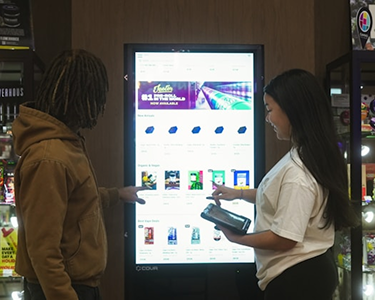
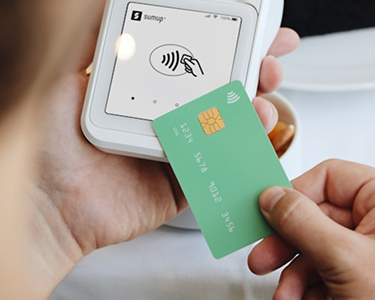





Skip the hiring process, get a senior PWA engineer embedded in your project within days. From Service Worker architecture and Workbox cache strategy through Lighthouse optimization and App Store deployment via TWA, we own the full PWA build.
10+ PWA developers available now · Service Workers, Workbox & Lighthouse specialists · React/Next.js, Angular & Vue.js delivery experience

PWA development done right requires deep Service Worker architecture knowledge, production Workbox caching experience, and the ability to achieve perfect Lighthouse PWA scores that translate into real performance improvements for real users. Here’s what makes our PWA engineering team the right technical partner for your build.

Our developers architect Service Worker implementations from scratch, configuring Workbox cache strategies including cache-first for static assets, network-first for API responses, and stale-while-revalidate for frequently updated content. We implement background sync, push notification delivery via Firebase Cloud Messaging, and offline fallback pages that keep your PWA functional under any network condition.

We engineer every PWA to achieve a perfect Lighthouse PWA score, covering Web App Manifest configuration, Service Worker registration and update handling, HTTPS enforcement, installability criteria, and splash screen configuration. Beyond PWA compliance, we optimize Core Web Vitals, LCP, CLS, and FID, using Next.js image optimization, code splitting, lazy loading, and CDN configuration that deliver measurably faster real-user performance.

Every PWA we build is served exclusively over HTTPS, a PWA prerequisite and a core security requirement. We implement Content Security Policy headers, secure API authentication via JWT and OAuth 2.0, encrypted data transmission, and OWASP-compliant JavaScript practices. For PWAs handling sensitive user data, healthcare, fintech, or enterprise, we apply additional security controls appropriate to the compliance requirements of the specific industry.

We run structured two-week sprint cycles with defined PWA deliverables, Service Worker implementation, Workbox configuration, Lighthouse audit results, and performance benchmark reports at each sprint milestone. Progress is tracked via Jira sprint boards and communicated through dedicated Slack channels, giving you full visibility into what's been built, what's been optimized, and what Lighthouse score improvements have been achieved at every stage.
We deploy PWAs to Google Play via Trusted Web Activity (TWA) and to the iOS App Store via WKWebView wrapper, giving your Progressive Web App full app store distribution without a separate native codebase. TWA deployment requires passing Google's quality criteria including Lighthouse performance thresholds, which our builds are specifically engineered to meet, so your PWA passes store review and maintains distribution eligibility as Google and Apple update their PWA acceptance criteria.

Post-launch we provide Lighthouse CI monitoring to catch performance regressions before they impact users, Service Worker update management, Workbox cache strategy refinement, push notification system health checks, browser compatibility updates as Chrome, Safari, and Firefox expand PWA API support, and TWA and WKWebView store submission management for app store distributed PWAs.
Every PWA project follows a structured seven-phase process built around Service Worker architecture, Workbox cache strategy implementation, and Lighthouse PWA optimization, with defined deliverables, two-week agile sprints, and full client visibility at every stage from requirements through post-launch monitoring.
We conduct stakeholder interviews, technical requirement workshops, and existing web infrastructure audits, defining business objectives, target platform scope, offline functionality requirements, and push notification use cases. This phase produces a full PWA specification covering Service Worker strategy, Workbox cache approach, frontend framework selection (React/Next.js, Angular, or Vue.js), Firebase vs REST backend decision, and a phased delivery roadmap with fixed sprint milestones.
We architect the complete PWA technical foundation, designing the app shell architecture for instant load performance, defining Service Worker scope and lifecycle management approach, selecting Workbox cache strategies for each asset and data type, configuring Web App Manifest for installability, and planning the push notification delivery system via Firebase Cloud Messaging. Every architectural decision is documented before a line of code is written.
We design PWA interfaces in Figma, building mobile-first, responsive layouts that adapt correctly from smartphone to desktop, designing offline state UI that handles connectivity loss gracefully, and producing high-fidelity interactive prototypes validated with stakeholders before development begins. Every design decision accounts for installed PWA behavior in standalone mode, so the experience matches native app conventions on both iOS and Android.
We implement Service Workers using Workbox, configuring cache-first strategies for static assets, network-first for API responses, and stale-while-revalidate for frequently updated content. We integrate the Push Notifications API with Firebase Cloud Messaging for re-engagement notifications, implement Background Sync API for offline action queuing, and build the complete PWA frontend on React/Next.js, Angular, or Vue.js in two-week agile sprints with end-of-sprint Lighthouse audit results shared at each milestone.
We integrate the Push Notifications API, configuring Firebase Cloud Messaging for reliable cross-platform notification delivery, implementing notification permission request flows that maximize opt-in rates, and building notification management systems that deliver timely, relevant alerts for order updates, content triggers, and personalized re-engagement campaigns. Every push notification implementation is tested across Chrome, Firefox, and Safari on iOS and Android before deployment.
We run a structured PWA QA cycle, covering Lighthouse PWA audit to verify perfect compliance score, Core Web Vitals measurement for LCP, CLS, and FID against Google's threshold targets, Service Worker offline functionality testing across Chrome and Safari, cross-device layout validation, push notification delivery testing, and App Store TWA compliance verification for Google Play distributed PWAs. Nothing proceeds to deployment until all Lighthouse criteria pass and client sign-off is confirmed.
We deploy the PWA via HTTPS with full production configuration, submitting to Google Play via Trusted Web Activity (TWA) and iOS App Store via WKWebView wrapper where app store distribution is required. Post-launch we monitor Lighthouse scores via Lighthouse CI, track Core Web Vitals via Chrome UX Report, manage Service Worker updates, and handle ongoing feature development in sprint cycles, keeping your PWA performant, compliant, and current across every browser and distribution channel it targets.
We conduct stakeholder interviews, technical requirement workshops, and existing web infrastructure audits, defining business objectives, target platform scope, offline functionality requirements, and push notification use cases. This phase produces a full PWA specification covering Service Worker strategy, Workbox cache approach, frontend framework selection (React/Next.js, Angular, or Vue.js), Firebase vs REST backend decision, and a phased delivery roadmap with fixed sprint milestones.
We architect the complete PWA technical foundation, designing the app shell architecture for instant load performance, defining Service Worker scope and lifecycle management approach, selecting Workbox cache strategies for each asset and data type, configuring Web App Manifest for installability, and planning the push notification delivery system via Firebase Cloud Messaging. Every architectural decision is documented before a line of code is written.
We design PWA interfaces in Figma, building mobile-first, responsive layouts that adapt correctly from smartphone to desktop, designing offline state UI that handles connectivity loss gracefully, and producing high-fidelity interactive prototypes validated with stakeholders before development begins. Every design decision accounts for installed PWA behavior in standalone mode, so the experience matches native app conventions on both iOS and Android.
We implement Service Workers using Workbox, configuring cache-first strategies for static assets, network-first for API responses, and stale-while-revalidate for frequently updated content. We integrate the Push Notifications API with Firebase Cloud Messaging for re-engagement notifications, implement Background Sync API for offline action queuing, and build the complete PWA frontend on React/Next.js, Angular, or Vue.js in two-week agile sprints with end-of-sprint Lighthouse audit results shared at each milestone.
We integrate the Push Notifications API, configuring Firebase Cloud Messaging for reliable cross-platform notification delivery, implementing notification permission request flows that maximize opt-in rates, and building notification management systems that deliver timely, relevant alerts for order updates, content triggers, and personalized re-engagement campaigns. Every push notification implementation is tested across Chrome, Firefox, and Safari on iOS and Android before deployment.
We run a structured PWA QA cycle, covering Lighthouse PWA audit to verify perfect compliance score, Core Web Vitals measurement for LCP, CLS, and FID against Google's threshold targets, Service Worker offline functionality testing across Chrome and Safari, cross-device layout validation, push notification delivery testing, and App Store TWA compliance verification for Google Play distributed PWAs. Nothing proceeds to deployment until all Lighthouse criteria pass and client sign-off is confirmed.
We deploy the PWA via HTTPS with full production configuration, submitting to Google Play via Trusted Web Activity (TWA) and iOS App Store via WKWebView wrapper where app store distribution is required. Post-launch we monitor Lighthouse scores via Lighthouse CI, track Core Web Vitals via Chrome UX Report, manage Service Worker updates, and handle ongoing feature development in sprint cycles, keeping your PWA performant, compliant, and current across every browser and distribution channel it targets.
Every technology in our PWA stack is selected for a specific reason, Service Worker reliability, cache strategy flexibility, Lighthouse compliance capability, and long-term browser support maturity. We build on web standards that are universally supported, production-proven, and engineered to meet Google’s PWA quality criteria across every target device and distribution channel








Every project below is a production-deployed Progressive Web App, built with Service Workers, Web App Manifest, and Workbox on React/Next.js, Angular, or Vue.js, with Firebase backend integration and push notification delivery via Firebase Cloud Messaging. Results are measured against real PWA KPIs including Lighthouse PWA score, Core Web Vitals performance, offline session reliability, push notification opt-in rate, and time-to-install from first visit.
From startup founders shipping their first offline-capable PWA to enterprise teams replacing native app downloads with an installable Progressive Web App, here’s what our clients say about ETechViral’s PWA engineering quality, Lighthouse optimization results, and the real-world performance of the progressive web apps we’ve built together.
Amir Khan and his team is very responsible and works well. We have worked together and have been able to produce a good quality application. It has been easy to manage the project and they has delivered well. I would recommend others to use his services as they provide 100% perfect services.
Amir Khan and his team is very responsible and works well. We have worked together and have been able to produce a good quality application. It has been easy to manage the project and they has delivered well. I would recommend others to use his services as they provide 100% perfect services.
Amir Khan and his team is very responsible and works well. We have worked together and have been able to produce a good quality application. It has been easy to manage the project and they has delivered well. I would recommend others to use his services as they provide 100% perfect services.
Everything you need to know about how we build, optimize, and deploy Progressive Web Apps using Service Workers, Workbox, and Web App Manifest, answered directly by our engineering team.
No vague proposals. No bloated timelines. Just a free 30-minute consultation with our PWA engineers, and a clear project scope with Lighthouse targets and delivery milestones delivered within 48 hours.
10+ PWA developers available now · Service Workers, Workbox & Lighthouse specialists · React/Next.js, Angular & Vue.js delivery experience