SaaS
Full Development
Austria
Mobile & Tablet
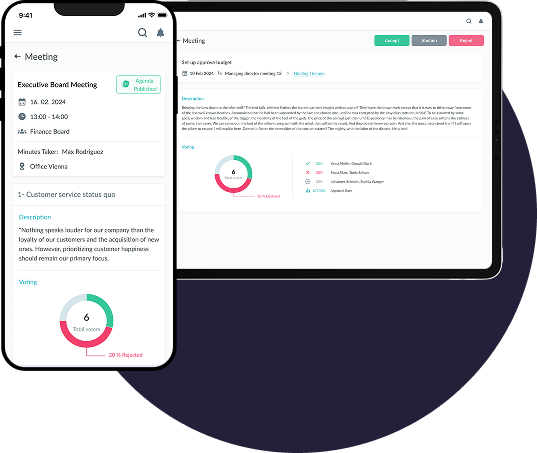
A board meeting produces decisions. Those decisions need to happen, and someone needs to make sure they do. The chain from agenda to meeting to decision to follow-up was broken at almost every point for most organisations.
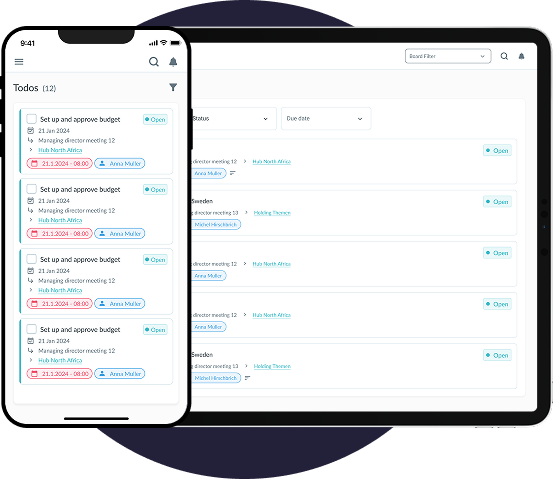
Agendas were sent by email. Documents lived in shared drives with no real access control. During meetings, voting happened by show of hands or verbal confirmation with no record attached to the agenda item. After meetings, minutes were written up separately by hand, sent around for corrections, chased for signatures, and stored in a folder that was hard to find later. Action items were noted in spreadsheets that nobody updated.
Decisions that were made in a meeting often went nowhere. A month later, nobody could confirm whether a resolution was acted on, who was responsible, or what the board had actually agreed to. For large regulated organisations, this is not just an efficiency problem, it is a compliance problem. An auditor asking for evidence of a governance decision should not receive a chain of emails.
Cross-platform iOS app development
Native watchOS companion app, required because Flutter has no watchOS support
Native Android bridge code
Cross-platform iOS app development
Native watchOS companion app, required because Flutter has no watchOS support
Native Android bridge code
Auth, Firestore database, Cloud Messaging (push notifications)
Firebase Cloud Functions, persona identification, session triggers, notification logic
Cloud infrastructure, function hosting, AI model serving
Firebase Cloud Functions, persona identification, session triggers, notification logic
Auth, Firestore database, Cloud Messaging (push notifications)
Firebase Cloud Functions, persona identification, session triggers, notification logic
Cloud infrastructure, function hosting, AI model serving
Firebase Cloud Functions, persona identification, session triggers, notification logic
Hours Saved Per Meeting
More Decision Actioned
Decision Implementation Rate
Apollo.ai is a live product in active use by enterprise clients across Austria and Europe. The product metrics the client publishes reflect what the platform achieves in real deployment: more than 10 hours saved per meeting, 25% more decisions followed through to completion, a 4x improvement in decision implementation rate.
The clients using Apollo.ai, OMV, PricewaterhouseCoopers, GETEC, DORDA, All for One, Verbund, Salzburg AG, CERAFILTEC, Ventocom, and Stadtwerke Klagenfurt, are large, regulated organisations in Austria and Europe with strict requirements for data security, compliance documentation, and governance process integrity. The platform handles their board operations.
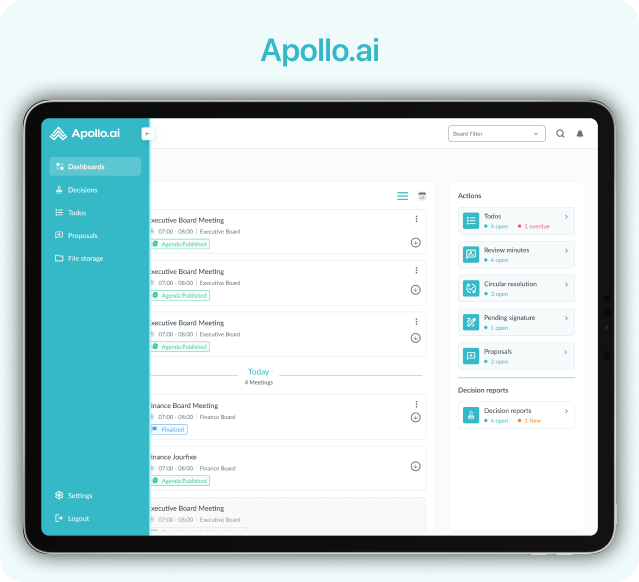
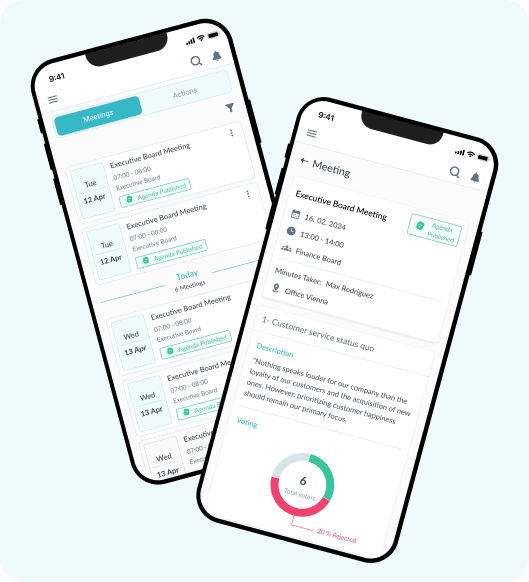
ETechViral built the complete product: every mobile and tablet screen in Flutter, the Node.js backend, the real-time voting engine, the circular resolution workflow, the minutes generation and sign-off pipeline, the file storage module, the decisions log, the audit trail, and the multi-board permission system, from first line of code to live deployment.