Flutter vs React Native: Which Should You Choose in 2026
Flutter vs React Native compared on rendering, performance, platform coverage, and ecosystem. A clear decision framework with concrete criteria for 2026 projects.
The Flutter vs React Native question is the most common technical decision in cross-platform mobile development. Both frameworks let a single team ship to iOS and Android. Both are backed by large technology companies with serious long-term investment. Both are in production at scale, at companies with millions of users. And yet the choice between them is genuinely consequential, architecture, rendering, performance ceiling, platform support, and team onboarding all differ in ways that affect real projects.
- Flutter owns its own rendering pipeline and draws pixels directly with Impeller; React Native delegates rendering to platform-native components.
- Flutter applications guarantee identical UI across iOS and Android by design; React Native requires extra effort to maintain visual parity.
- Flutter compiles Dart to native ARM code with no bridge; React Native's New Architecture (JSI + Fabric) closes much of the historical performance gap.
- Flutter supports six stable platforms; React Native's first-party targets are iOS and Android.
- React Native wins on JavaScript ecosystem reuse and team onboarding from web; Flutter wins on rendering consistency and performance ceiling.
- The Core Architectural Difference
- Architecture Difference, Old vs New, Skia vs Impeller
- Performance Comparison
- Platform Coverage, Desktop and Web Support
- Language and Ecosystem, Dart vs JavaScript
- When Flutter Is the Right Choice
- When React Native Is the Right Choice
- Side-by-Side Comparison Table
- The Question to Ask Before Deciding
- Next Steps
- Frequently Asked Questions
This article is part of our Complete Guide to Flutter App Development, which covers every major Flutter decision from architecture and state management through CI/CD and enterprise deployment. Reference points include the React Native architecture overview and Flutter Impeller documentation. If you have already decided on Flutter and want to understand how to structure a project, move to our Flutter architecture guide. If you are still at the framework evaluation stage, read on.
If you are ready to discuss your project directly, our Flutter development team is available for a free consultation.
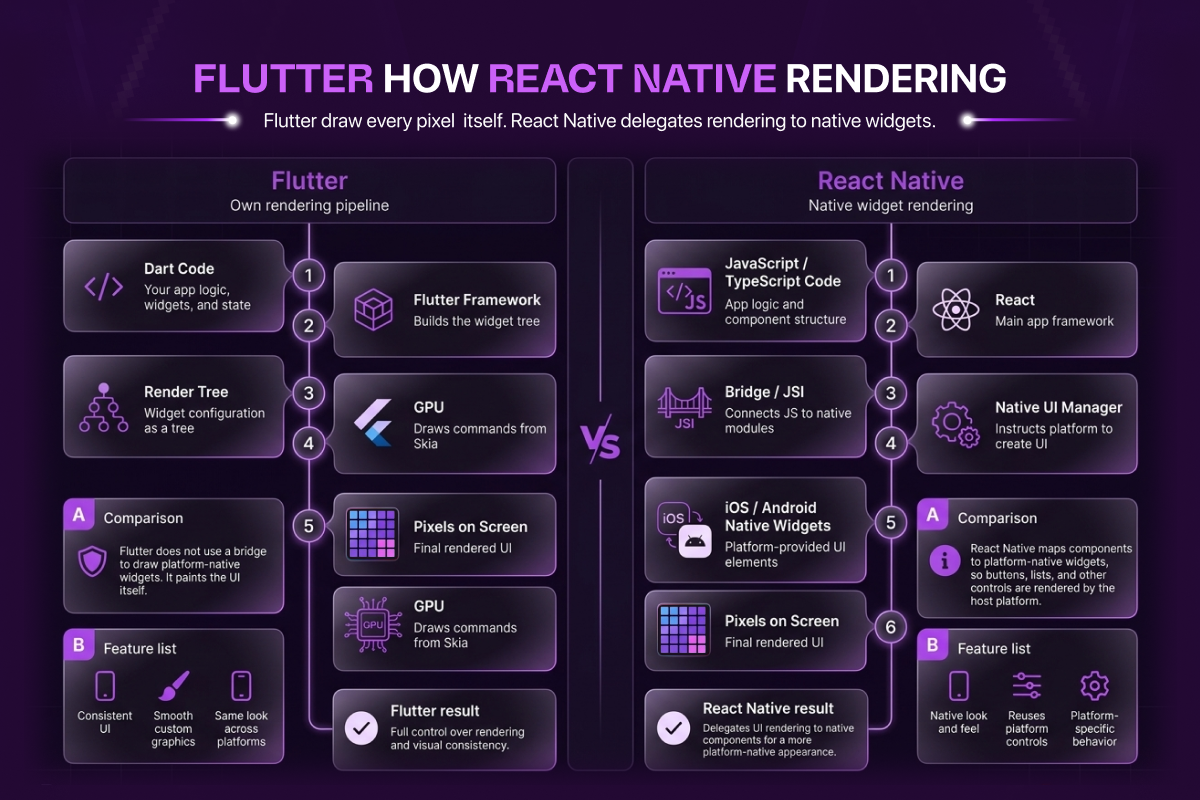
Diagram: Flutter draws every pixel itself, React Native delegates rendering to native widgets.
Flutter vs React Native at a Glance
| Dimension | Flutter | React Native |
|---|---|---|
| Rendering | Draws every pixel with its own engine (Skia/Impeller) | Maps to platform-native UI components |
| Performance | Near-native; Dart compiles to native ARM with direct GPU access | Good; improved by the New Architecture (JSI), with some bridge overhead |
| UI consistency | Pixel-identical across platforms by design | Varies with each platform's native components and OS updates |
| Team size / skills | One small team ships all platforms from a single codebase; requires adopting Dart | Fastest when the team already knows JavaScript/React |
| Ecosystem | Younger but fast-growing, Google-backed, all-in-one | Mature JavaScript/npm ecosystem with a larger third-party library pool |
Which Should You Choose?
Choose Flutter if you want pixel-identical UI across iOS, Android, web, and desktop from one codebase, predictable near-native performance, and you are comfortable adopting Dart. Choose React Native if your team already lives in JavaScript and React and reusing that ecosystem matters more than perfect cross-platform UI parity. For most new cross-platform projects that prioritise consistent UI and long-term performance, Flutter is the stronger default; React Native wins when existing JavaScript expertise is the deciding factor.
Where we stand: ETechViral builds in Flutter, for the reasons set out above, and it is our default recommendation for new cross-platform projects. That is also why the React Native sections here are not softened. If your team lives in JavaScript, or you are extending an existing React Native codebase, that is a real reason to choose it, and we will tell you so.
The Core Architectural Difference, How Each Framework Renders UI
Everything else in the Flutter vs React Native comparison, performance, consistency, platform support, ecosystem, flows from one fundamental architectural difference: how each framework gets pixels on screen.
React Native bridges JavaScript to platform-native components. When you write <Text> in React Native, it tells iOS to render a UILabel and tells Android to render a TextView. The platform's own rendering pipeline draws those components. This means React Native UI looks native because it literally is native, the operating system is doing the drawing, using the same components that a fully native Swift or Kotlin application would use.
The downside of this approach is the bridge itself. The original React Native architecture serialised data across an asynchronous JavaScript bridge, which introduced latency and was a common source of performance problems in complex UIs. The React Native New Architecture, introduced progressively from React Native 0.68 onwards, replaced this with JSI (JavaScript Interface), which allows JavaScript to call native functions synchronously, and the Fabric renderer, which rebuilds the UI layer from scratch. New Architecture has closed meaningful performance gaps, but it still delegates rendering to platform components.
Flutter owns its own rendering pipeline end to end. Flutter does not call UILabel or TextView. It requests a blank surface from the operating system and draws every pixel itself using its own graphics engine, first Skia, now Impeller on iOS and progressively on Android. A Flutter Text widget is drawn by Flutter's engine, not by the platform. This is how Flutter guarantees identical visual output on iOS and Android, there is no platform component to vary.
The practical impact of this difference is not abstract. It means:
- A Flutter UI in a Figma design can be reproduced pixel-for-pixel on both platforms simultaneously
- A React Native UI that uses platform components may render with slight differences in typography, shadow handling, and touch feedback between iOS and Android
- Flutter's performance ceiling for complex animations is determined by the GPU, not by the speed of a JavaScript bridge
Architecture Difference, Old vs New, Skia vs Impeller
React Native, Old Architecture vs New Architecture
The old React Native architecture used three threads: a JavaScript thread running application logic, a native thread running platform UI, and a shadow thread handling layout. Communication between JavaScript and native happened through a serialised JSON bridge. Every state change in JavaScript had to be serialised, passed across the bridge, deserialised, and applied to native components. At high frequency, rapid list scrolling, gesture tracking, continuous animations, this bridge was the bottleneck.
The React Native New Architecture (JSI + Fabric + TurboModules + the new Codegen system) addresses this directly. JSI allows JavaScript to hold direct references to native objects and call native functions synchronously. Fabric rebuilds the UI layer with a concurrent rendering model compatible with React 18. The practical result is that React Native New Architecture applications have significantly better frame rates and lower touch latency than old architecture applications for the same code.
However, New Architecture migration is not automatic, many existing React Native applications still run on the old architecture, and some popular third-party libraries have not yet been updated to support New Architecture.
Flutter, Impeller and the Elimination of Shader Jank
Flutter's rendering pipeline has no bridge to cross. Application Dart code calls Flutter framework APIs, which call the engine, which writes to a GPU texture. On mobile, this happens on two threads: the UI thread (Dart + framework) and the raster thread (engine + GPU commands). The separation means that a frame being prepared on the UI thread does not block a frame being drawn by the raster thread.
The original Skia engine had one notable weakness: shader compilation jank. The first time a complex animation played, the GPU had to compile the shader programs required to draw it, causing a brief but visible stutter. Impeller, now the default on iOS and rolling out to Android, pre-compiles all shaders at build time. There is no first-frame stutter because there is no runtime shader compilation.
For production applications where animation smoothness is a quality signal, consumer apps, onboarding flows, branded experiences, Impeller is a meaningful infrastructure advantage.
Performance Comparison, Flutter vs React Native
Raw performance comparisons between Flutter and React Native are complicated by the fact that both frameworks produce good performance in the vast majority of real applications. A well-built React Native application and a well-built Flutter application will both feel fast and responsive for the most common mobile use cases, forms, lists, navigation, network data display.
The differences emerge at the edges:
Complex animations and continuous gesture tracking, Flutter leads here. Drawing directly to the GPU with no bridge overhead means Flutter can maintain 60fps and 120fps frame rates on demanding animations where React Native New Architecture can still struggle. The absence of shader jank with Impeller is a specific, measurable advantage.
List performance with large datasets, both frameworks handle this well when implemented correctly. Flutter's ListView.builder and React Native's FlatList both virtualise rendering, constructing only visible items. The implementation pattern matters more than the framework choice here.
App startup time, React Native applications start the JavaScript runtime on launch, which adds to cold start time. Flutter applications execute native ARM code directly, which gives Flutter a marginal cold start advantage on equivalent hardware.
Memory usage, Flutter embeds its rendering engine in every application binary, which adds approximately 4-6MB to the final app size compared to a React Native application of equivalent functionality. This is rarely a practical concern but is worth knowing for low-storage device targeting.
CPU-intensive logic, both frameworks run business logic on a background thread or isolate. Flutter's Dart isolates and React Native's JavaScript workers both allow CPU-heavy work off the main thread. Neither has a structural advantage here.
The honest summary: for 80% of production mobile applications, social features, content browsing, e-commerce, productivity tools, performance is not the deciding factor between Flutter and React Native. Both produce applications that users cannot distinguish from native on feel alone. Performance becomes the deciding factor for applications with demanding real-time UIs, gaming, data visualisation, or continuous sensor data rendering.
Platform Coverage, Desktop and Web Support
This is where Flutter has a structural advantage that React Native does not match.
Flutter supports six stable platforms: iOS, Android, Web, Windows, macOS, and Linux, all as first-party, Google-maintained stable targets as of Flutter 3.0. A single Flutter codebase can produce a production-ready desktop application for Windows and macOS alongside the mobile applications, with the same business logic, state management, and data layers shared across all six targets.
React Native's primary targets are iOS and Android. React Native Windows and React Native macOS exist as community projects maintained by Microsoft, but they are not first-party React Native releases and have notably less maturity, smaller communities, and more limited API coverage than the mobile targets.
For teams whose project scope includes a desktop application, internal enterprise tooling that needs to run on employee laptops as well as employee phones, for example, Flutter removes the need for a separate desktop development effort entirely. This is one of the clearest cases where Flutter's platform strategy is a genuine competitive advantage over React Native.
Web support for both frameworks is real but limited relative to purpose-built web frameworks. Flutter web works well for internal tools, dashboards, and progressive web apps. React Native web (via React Native Web, maintained by the community) is used by major companies including Twitter/X but requires careful configuration. Neither is the default choice for a team whose primary deliverable is a web application.
Language and Ecosystem, Dart vs JavaScript
React Native uses JavaScript or TypeScript, the language of the web. For teams with existing web development experience, React developers, Node.js developers, or full-stack JavaScript engineers, this is a meaningful advantage. There is no new language to learn. TypeScript adds static typing. The NPM ecosystem provides access to hundreds of thousands of packages, and many of them work in React Native directly.
Flutter uses Dart, a language developed by Google that will be new to most developers coming from web or native backgrounds. Dart is statically typed, has modern async/await syntax, and has sound null safety, it is not a difficult language to learn, but it is a language that must be learned. Most developers with experience in any typed language report reaching productive Dart fluency within one to two weeks.
The Flutter package ecosystem on pub.dev is smaller than NPM but has grown rapidly and covers the common requirements of production mobile development comprehensively. First-party packages from Google (FlutterFire for Firebase, google_maps_flutter, camera, image_picker, and dozens more) are maintained to a high standard. The ecosystem gap with NPM is real but rarely a blocker for mobile-specific requirements.
When Flutter Is the Right Choice
Flutter is the right choice when:
- Pixel-perfect visual consistency across iOS and Android is a design or brand requirement, Flutter's single renderer guarantees identical output
- Complex animations, gesture-driven interactions, or custom drawing are a core part of the product, Flutter's performance ceiling is higher and more predictable
- Desktop support, Windows, macOS, or Linux, is part of the project scope alongside mobile
- You are starting a new project with no existing JavaScript codebase that benefits from continuity with React Native
- Your team is new to both Dart and JavaScript and is learning either way, Dart's learning curve is similar to TypeScript for developers with Java or Swift backgrounds
- Long-term performance headroom matters, Flutter's direct-to-GPU architecture scales better as UI complexity increases
Understanding how Flutter scales requires understanding its architecture decisions. Our Flutter Clean Architecture guide covers how production Flutter projects are structured for long-term maintainability, and our Flutter state management comparison covers how Bloc and Riverpod handle application state differently.
When React Native Is the Right Choice
React Native is the right choice when:
- Your team consists of JavaScript or TypeScript developers and retraining cost and timeline are real constraints, the language continuity advantage is genuine
- You are migrating from a React web application to mobile and want to share component logic, hooks, or business logic between the web and mobile codebases
- Your application uses standard platform UI components, navigation bars, tab bars, standard form elements, and visual consistency between iOS and Android is not a strict requirement
- You have an existing React Native codebase and are evaluating whether to continue or migrate, migrating an existing React Native application to Flutter is a significant undertaking and requires a clear justification
- Your third-party integrations rely on native SDKs that have React Native wrappers but no Flutter plugins, though this scenario has become less common as the Flutter ecosystem has matured
Side-by-Side Comparison Table
| Dimension | Flutter | React Native |
|---|---|---|
| Language | Dart | JavaScript / TypeScript |
| Rendering | Own engine (Skia/Impeller) | Platform native components |
| UI consistency across platforms | Pixel-perfect by design | Platform-dependent variations possible |
| Performance ceiling | Near-native, direct GPU | Good, improved with New Architecture |
| Shader jank | Eliminated by Impeller | Not applicable |
| Stable platform targets | iOS, Android, Web, Windows, macOS, Linux | iOS, Android (Web via community) |
| Desktop support | First-party, stable | Community projects (Windows, macOS) |
| Package ecosystem | pub.dev, growing, strong first-party | NPM, very large, broad coverage |
| Learning curve (new dev) | Dart: 1-2 weeks for typed-language devs | Minimal for existing JS/TS developers |
| App binary size overhead | +4-6MB for embedded engine | Minimal |
| Hot reload | Yes | Yes |
| Backed by | Meta |
The Question to Ask Before Deciding
The most practical way to make this decision is to answer three questions about your specific project:
Does your UI need to be pixel-perfect across platforms? If yes, Flutter's rendering model makes this structurally guaranteed. React Native can achieve visual consistency with careful work, but it requires active effort to maintain.
Does your team write JavaScript today? If yes, the onboarding argument for React Native is real. If not, if your team writes Java, Swift, Kotlin, Python, or any other language, the argument disappears and Dart's learning curve is comparable to TypeScript's.
Do you need desktop? If yes, Flutter is the only choice with first-party stable desktop support.
If the answers to all three are no, yes, and no, React Native is probably the right choice for your specific situation. If the answers are yes, no, and yes, Flutter is clearly the right choice. For the cases in between, the decision should be driven by your UI requirements and performance targets, not by framework popularity or which one a developer on the team already knows.
Next Steps
If this comparison has helped you land on Flutter, the next decision is architecture, how you structure the codebase determines whether the project scales cleanly or accumulates technical debt. Our Flutter architecture guide covers Clean Architecture, layer separation, and folder structure with concrete examples, and the Complete Guide to Flutter App Development maps out every decision from there through deployment.
If you would rather have an experienced team build it, our Flutter app development team is available to discuss your project.
Frequently Asked Questions About Flutter vs React Native
Is Flutter better than React Native in 2026?
Neither is universally "better", the decision depends on three concrete factors: your UI consistency requirements, your team's existing language expertise, and whether you need desktop support. Flutter wins on pixel-perfect cross-platform consistency, performance ceiling for complex animations, and first-party desktop support. React Native wins on JavaScript ecosystem access and onboarding speed for teams with existing React expertise. For most new projects starting from scratch, Flutter is the technically stronger choice. For teams with deep React Native expertise or existing React web codebases to share with, React Native remains a serious contender.
Which is faster: Flutter or React Native?
For 80% of mobile applications, the perceived performance is indistinguishable. Both frameworks produce smooth, responsive UIs for typical use cases. The gap appears at the edges: complex animations, continuous gesture tracking, and high-frequency UI updates. Flutter has a higher performance ceiling here because it draws directly to the GPU with no bridge. React Native's New Architecture has closed much of the historical gap, but Flutter still leads on the most demanding workloads.
Can I migrate an existing React Native app to Flutter?
Yes, but it is essentially a rewrite. The languages (JavaScript vs Dart) and frameworks are different enough that no automated migration tool exists, and code cannot be shared between the two. Migration makes sense when the React Native codebase has hit a wall, typically because of performance issues, ecosystem limitations, or scaling problems, that Flutter would solve. Migration purely for technology preference is rarely justified.
Which has better community support and third-party libraries?
React Native has the larger ecosystem by raw package count because it inherits from NPM. Flutter's pub.dev is smaller but growing rapidly, with strong first-party support from Google for the common mobile requirements (Firebase, Maps, camera, image picker, video, etc.). For most production mobile applications, the ecosystem gap is rarely a blocker, both frameworks cover the standard requirements comprehensively. Specialised libraries (AR, advanced audio, niche hardware integrations) may favour one or the other on a case-by-case basis.
Which is cheaper to develop in, Flutter or React Native?
Development cost is determined more by team experience and project complexity than by framework choice. A team experienced in Flutter will deliver a Flutter app faster than a Flutter app built by a team experienced in React Native, and vice versa. For new projects with no existing team, Flutter typically requires slightly more upfront learning (Dart) but compensates with higher UI development velocity due to the unified widget model. Both produce similar total costs for equivalent scope.
Does Flutter or React Native produce better-looking apps?
Both can produce excellent UI. Flutter's structural advantage is that the same UI looks identical on iOS and Android by default, useful for branded consumer applications where visual consistency is a requirement. React Native's structural advantage is that the UI feels native on each platform by default, useful for applications where users expect platform-conventional behaviour. Both can be styled to match either pattern with effort.
Should I learn Flutter or React Native first as a beginner?
If you already know JavaScript, React Native gets you productive faster. If you are starting from zero, no prior web or mobile experience, Flutter's widget model is arguably easier to internalise than React Native's mix of React patterns and native bridging. Both are excellent first frameworks for mobile development. For developers planning a long career in mobile, learning both eventually is valuable; learning Flutter first if you have any typed-language background (Java, Swift, Kotlin, TypeScript) is the smoother path.