Flutter Healthcare App Development: HIPAA, FHIR & Architecture
How to build HIPAA-compliant healthcare apps in Flutter: PHI architecture, secure storage, HL7/FHIR integration, and regulated release pipelines.
Flutter is a strong fit for healthcare app development because a single Dart codebase produces natively compiled iOS and Android builds, while the compliance burden sits where it always has: in how the application handles protected health information. Flutter is not "HIPAA compliant" on its own, and no framework is. Compliance comes from your architecture, storage, transport, access control, audit logging, and the agreements you sign with your infrastructure providers.
- No framework is HIPAA compliant by itself. Flutter is a UI toolkit; compliance is determined by how the app stores, transmits, and controls access to protected health information (PHI).
- Keep PHI out of the presentation layer. A clean Domain and Data separation makes access paths auditable and the business rules testable without a device.
- Encrypt PHI at rest using the platform keystores (iOS Keychain, Android Keystore) through
flutter_secure_storage. Never place PHI in SharedPreferences or unencrypted local databases. - HL7 v2 and FHIR R4 are the two integration surfaces you will meet when connecting to EHR and EMR systems.
- Regulated releases need reproducible CI/CD and a documented, repeatable test trail, not manual builds from a developer laptop.
- Why Flutter Works for Healthcare Apps
- What HIPAA and GDPR Actually Require From the App
- Architecting a Flutter Healthcare App Around PHI
- Securing PHI on the Device
- Connecting to EHR and EMR Systems With HL7 and FHIR
- Building Telemedicine Features in Flutter
- Testing and Releasing in a Regulated Environment
- A Real Build: DentaSmart
- Next Steps
- Frequently Asked Questions
This guide is written for teams building clinical or patient-facing products: EHR and EMR front ends, telemedicine platforms, patient portals, remote patient monitoring, and practice management tools. It is part of our Complete Guide to Flutter App Development, focused specifically on what changes when the data you are moving is health data. For the broader delivery picture, see our healthcare software development services.
Ready to build? Our Flutter app development team is available for a free consultation.
Why Flutter Works for Healthcare Apps
Healthcare products are rarely single-platform. A patient app needs iOS and Android on day one, clinicians often use tablets, and administrators expect a web view of the same data. Flutter compiles one Dart codebase to all of those targets, which matters more in healthcare than in most sectors because every additional codebase is another surface you must validate, document, and re-certify when requirements change.
Three properties make the difference in practice:
- One codebase, one validation effort. Clinical logic such as dosage rules, triage scoring, or eligibility checks is written once in Dart and tested once, instead of being reimplemented in Swift and Kotlin where the two can silently diverge.
- Pixel-identical UI across platforms. Flutter renders its own widgets rather than mapping to platform controls, so a consent flow or a medication chart looks and behaves the same everywhere. That consistency is easier to document and easier for staff to be trained on.
- Native performance for data-heavy screens. Flutter compiles ahead of time to native ARM code, which keeps long patient lists, charting views, and monitoring dashboards responsive.
What Flutter does not do is make you compliant. It gives you a fast, controllable client. The obligations below are yours regardless of framework.
What HIPAA and GDPR Actually Require From the App
HIPAA does not certify software. There is no badge a Flutter package can carry. What regulators care about is whether protected health information is safeguarded across its lifecycle, and the client application is responsible for a specific slice of that.
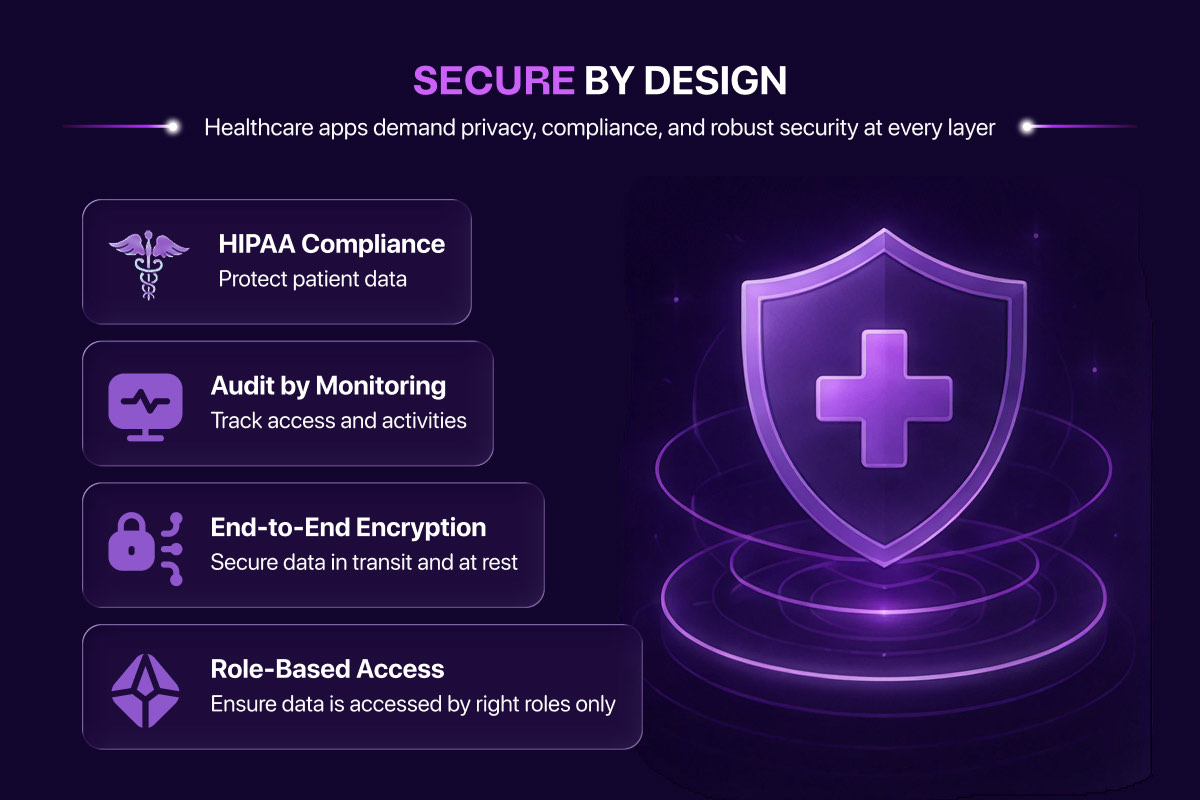
Diagram: the controls a Flutter healthcare app is responsible for, access control, audit logging, encryption in transit and at rest, and role based permissions.
In practice, a Flutter healthcare app is expected to handle the following:
- Access control. Every user is authenticated, sessions expire, and the app enforces role boundaries so a patient cannot reach clinician-only data even if an API is called directly.
- Encryption in transit. All PHI travels over TLS. Certificate pinning is a reasonable addition for high-risk deployments.
- Encryption at rest. Anything cached locally, including offline records and attachments, is encrypted using platform-backed keys.
- Audit trail. Access to PHI is logged server side with user, record, action, and timestamp. The client must send enough context for those logs to be meaningful.
- Minimum necessary data. The app requests only the fields it needs. Do not cache an entire patient record to render a summary card.
- Business Associate Agreements. Any vendor that touches PHI, including your cloud, analytics, crash reporting, and messaging providers, needs a BAA. This is a procurement decision that directly constrains which SDKs you may embed.
GDPR adds obligations that overlap but are not identical: a lawful basis for processing, data subject access and erasure, and data residency. If you serve EU patients, decide early where records live, because that decision shapes your infrastructure and your API design.
The practical consequence for a Flutter team is that third-party SDK choices become compliance decisions. A crash reporter that uploads a stack trace containing a patient identifier is a breach, not a bug.
Architecting a Flutter Healthcare App Around PHI
The single most useful structural decision is to keep PHI out of the presentation layer and behind an explicit boundary. This is exactly what Clean Architecture gives you, and it is why we use it as the default for regulated products. Our Flutter Clean Architecture guide covers the full pattern with code; here is what changes when the data is clinical.
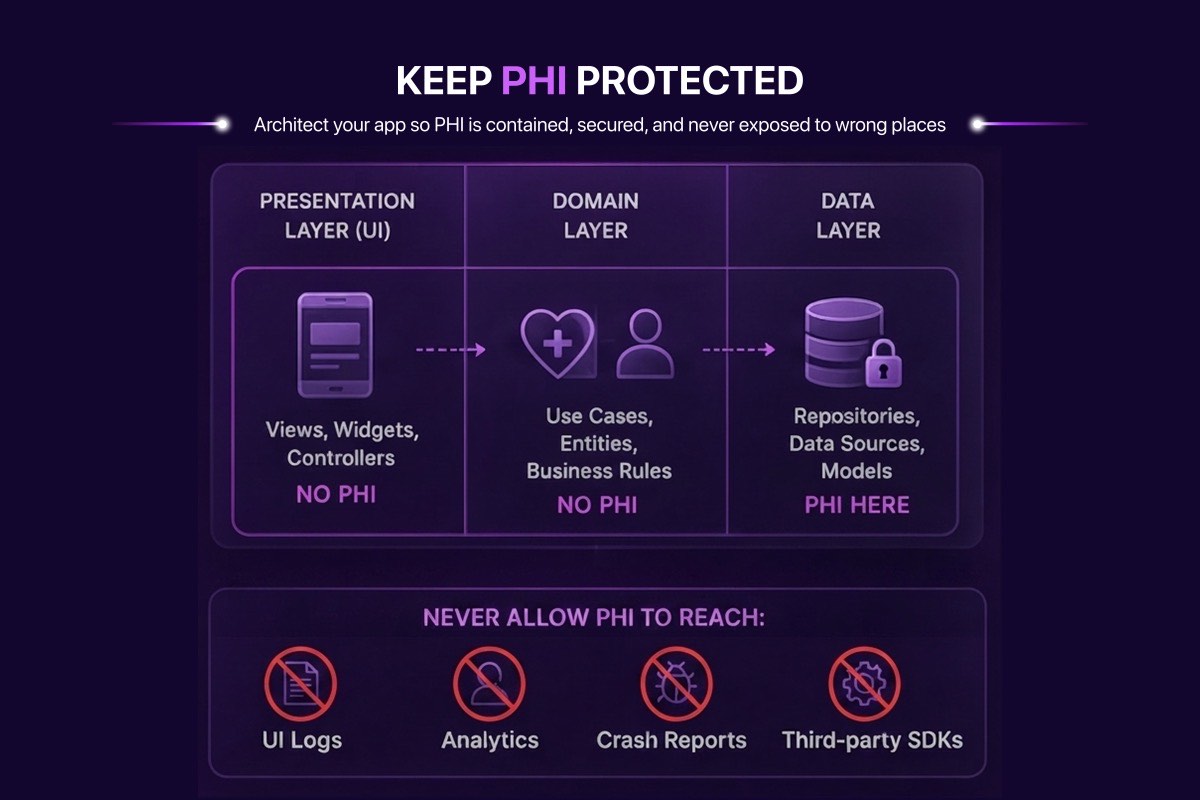
Diagram: PHI lives in the data layer only. The presentation and domain layers hold none, and it must never reach logs, analytics, crash reports, or third party SDKs.
- Domain layer. Entities and use cases describe clinical concepts in pure Dart with no Flutter or network imports. A use case such as
GetPatientSummarybecomes the single, testable place where the rules about what a role may see are enforced. - Data layer. Repository implementations own every path PHI can take: API clients, secure caches, and any mapping to and from HL7 or FHIR payloads. Because it is one layer, it is the one place a reviewer must audit.
- Presentation layer. Widgets receive view models that contain only the fields being displayed. If a screen shows initials and an appointment time, the widget should never hold the full record.
Two rules matter more in healthcare than elsewhere. First, no PHI in global or ambient state: keep it scoped to the screen that needs it and dispose it when that screen closes. Second, no PHI in logs, analytics events, or crash reports. Both are easy to enforce with a boundary and nearly impossible to enforce without one.
Securing PHI on the Device
Mobile devices are lost, shared, and stolen. Treat anything written to disk as recoverable by someone who is not the patient.
- Use the platform keystores.
flutter_secure_storagestores values in the iOS Keychain and the Android Keystore. Tokens, refresh credentials, and any cached identifiers belong there. SharedPreferences and plain SQLite files do not qualify. - Encrypt local databases. If the product needs offline access to records, use an encrypted store and derive the key from the platform keystore rather than shipping it in the binary.
- Add biometric or PIN re-authentication. The
local_authpackage gates re-entry after backgrounding, which is the most common real-world exposure. - Set an inactivity timeout. Clear in-memory PHI and require re-authentication after a defined idle period.
- Disable screenshots on PHI screens where policy requires it, and be deliberate about what appears in the app switcher preview.
- Do not put PHI in push notifications. Send an opaque prompt and load the detail inside the authenticated app.
Connecting to EHR and EMR Systems With HL7 and FHIR
Healthcare apps rarely own their data. Records usually live in an EHR or EMR, and you will meet one of two integration surfaces.
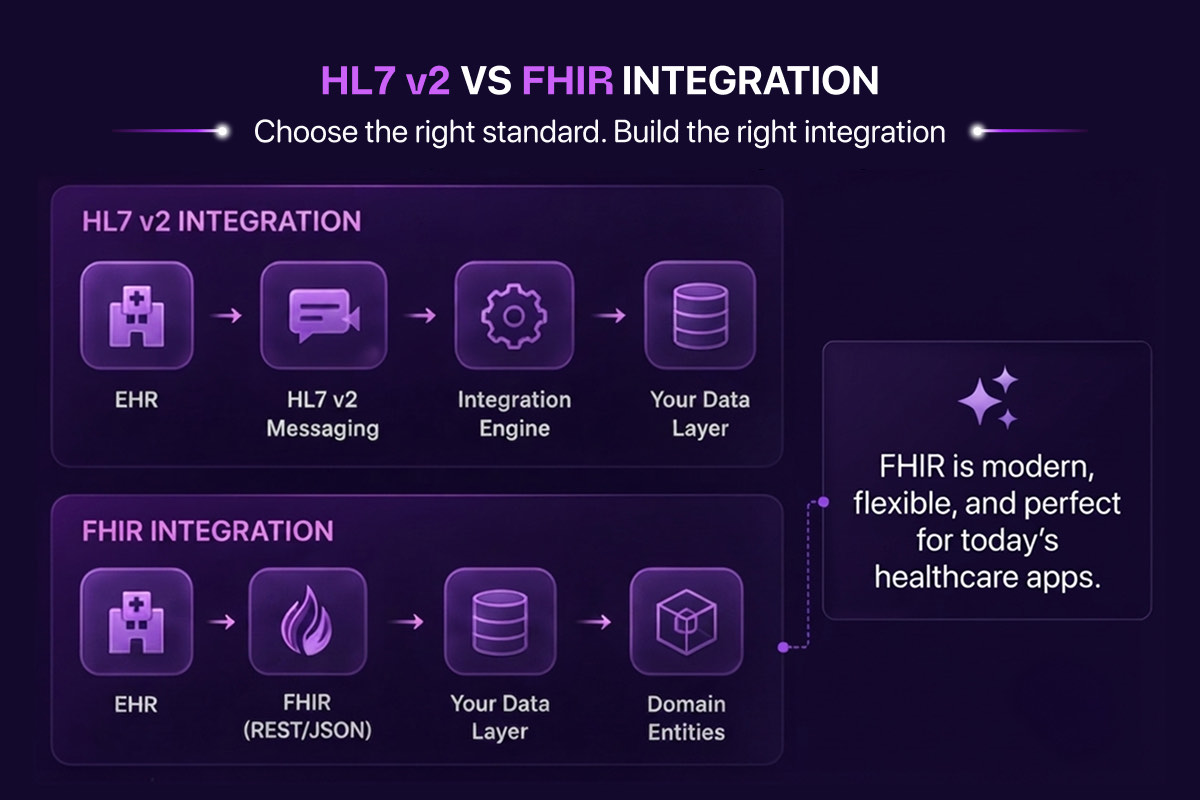
Diagram: the two EHR integration paths. HL7 v2 messages route through an integration engine, while FHIR resources map through your data layer into domain entities.
HL7 v2 is the older, pipe-delimited messaging standard still widely deployed for admissions, orders, and results. It is typically handled by an integration engine on the server side rather than parsed on the device.
FHIR is the modern REST and JSON standard, organised into resources such as Patient, Encounter, Observation, and Appointment. FHIR maps cleanly onto a Flutter data layer: each resource becomes a model, and repositories translate those models into the domain entities your use cases consume.
The architectural recommendation is the same in both cases: do not let FHIR or HL7 shapes leak into your widgets. Map them to domain entities in the data layer. EHR vendors change payloads, add extensions, and vary in how strictly they follow the spec, and you want that churn contained in one layer rather than spread across your UI.
Building Telemedicine Features in Flutter
Telemedicine adds real-time video, secure messaging, and scheduling on top of the record layer. Video is the part teams underestimate: it needs a media stack, signalling, TURN servers for restrictive networks, and a plan for degraded connections, which is a different discipline from CRUD screens. We cover that stack separately in our WebRTC development services.
From the Flutter side the requirements are practical: keep the call session isolated from the record screens, ensure consent is captured and logged before a session starts, and make sure that if the call drops, no PHI is left rendered on a screen that is no longer authenticated.
Testing and Releasing in a Regulated Environment
In regulated products, "it works on my machine" is not only a quality problem, it is an evidence problem. You need to be able to show what was tested and what was shipped.
- Unit-test the clinical rules. Because the domain layer is pure Dart, eligibility, dosage, and access rules can be tested exhaustively without a device. That is the test suite an auditor cares about.
- Widget-test the consent and error paths, not just the happy path. Consent capture, session expiry, and permission-denied states are where compliance failures show up.
- Integration-test the critical journeys, such as login, view record, book appointment, and join consultation.
Our Flutter testing guide covers how to write each layer. For release, builds should be reproducible and produced by a pipeline rather than a laptop, with signing credentials held as secrets and every release traceable to a commit. Our Flutter CI/CD guide covers that setup with Fastlane and GitHub Actions.
A Real Build: DentaSmart
DentaSmart is a dental care product we built that combines AI and 3D technology for clinical use. It is a useful reference point because it shows the pattern described above in a real deployment: a clinical workflow, patient data handled deliberately, and a cross-platform client. You can read the full breakdown on the DentaSmart case study, and see the wider set of products on our portfolio.
Next Steps
Flutter gives healthcare teams a fast, consistent client across iOS, Android, and web from one codebase. The compliance work is real but it is architectural: put a boundary around PHI, encrypt what you store, control who can reach what, and make your releases reproducible. None of that is framework-specific, which is precisely why Flutter does not get in the way.
If you are scoping a clinical or patient-facing product, our healthcare software development team and our Flutter app development service can help you plan the architecture and the compliance surface before code is written. Book a free consultation.
Frequently Asked Questions About Flutter for Healthcare
Is Flutter HIPAA compliant?
No framework is HIPAA compliant by itself, including Flutter. HIPAA applies to how protected health information is stored, transmitted, and accessed, not to the UI toolkit used to draw the screens. A Flutter app can absolutely be part of a HIPAA-compliant system when it authenticates users, encrypts PHI in transit and at rest, enforces role-based access, avoids leaking PHI into logs or analytics, and runs on infrastructure covered by Business Associate Agreements.
Can Flutter connect to an EHR or EMR system?
Yes. Most modern integrations use FHIR, a REST and JSON standard whose resources such as Patient, Encounter, and Observation map cleanly onto a Flutter data layer. Older systems often use HL7 v2 messaging, which is normally handled by a server-side integration engine rather than parsed on the device. In both cases you should map the external payloads to your own domain entities in the data layer so vendor changes do not reach your widgets.
Where should a Flutter app store patient data on the device?
Use platform-backed secure storage. flutter_secure_storage writes to the iOS Keychain and the Android Keystore, which is where tokens and identifiers belong. If the product needs offline records, use an encrypted database with a key derived from the keystore. Do not store PHI in SharedPreferences, in plain SQLite files, or in push notification payloads.
Is Flutter a good choice for telemedicine apps?
Yes, with the caveat that real-time video is its own engineering discipline. Flutter handles the application shell, scheduling, records, and messaging well from one codebase. The video layer needs a proper WebRTC stack including signalling and TURN servers for restrictive networks, plus a plan for degraded connections and for clearing PHI from the screen if a session ends unexpectedly.
What is the biggest architectural mistake in Flutter healthcare apps?
Letting protected health information spread across the presentation layer and into ambient state, logs, or analytics. Once PHI is scattered, you cannot answer basic audit questions about who could reach which record. Keeping PHI behind a Domain and Data boundary, as in Clean Architecture, means access rules live in testable use cases and every path to PHI is contained in one auditable layer.