Flutter Fintech App Development: PCI DSS, KYC & Security
How to build secure fintech apps in Flutter: staying out of PCI scope, exact money handling, KYC and open banking flows, and regulated release pipelines.
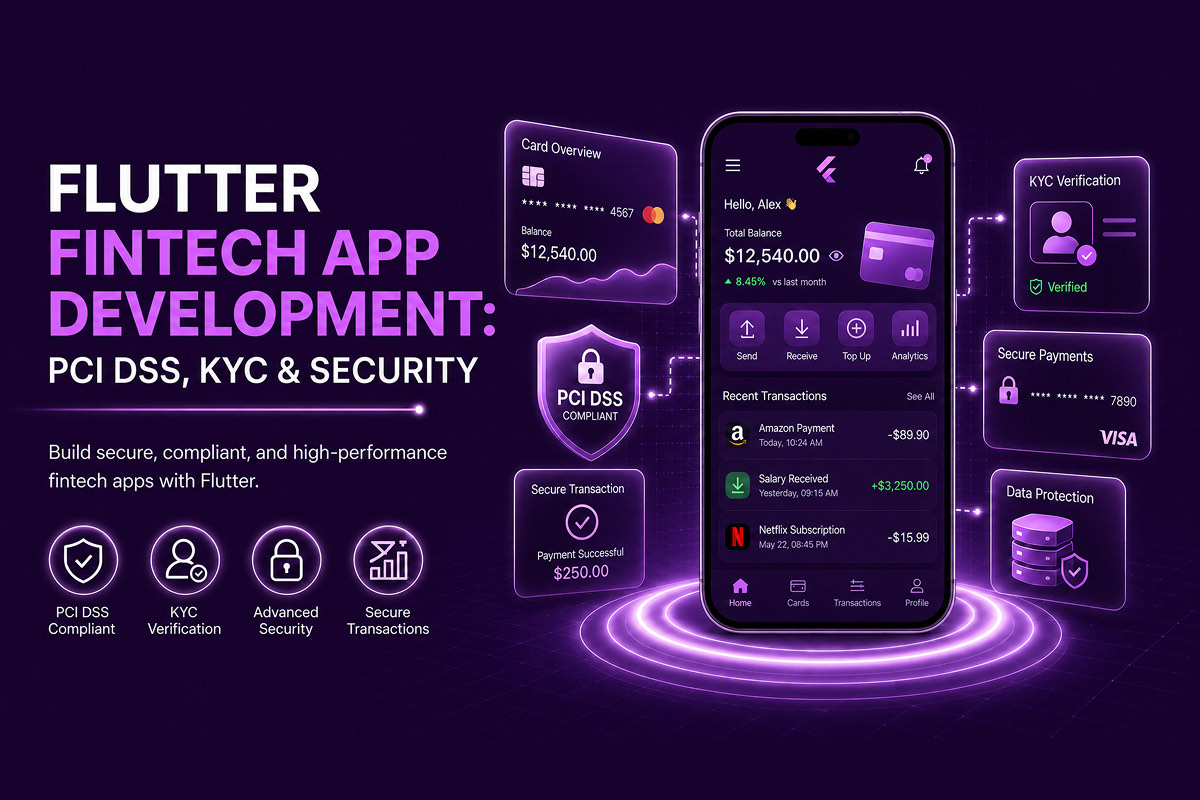
Flutter is a practical choice for fintech app development because one Dart codebase produces natively compiled iOS and Android builds, which matters when every release has to clear the same security review. Flutter does not make an application PCI DSS compliant, and no framework does. What determines compliance is how the app handles card data, credentials, and customer identity, and how much of that data you can avoid touching in the first place.
- The cheapest way to satisfy PCI DSS is to keep raw card numbers out of your app entirely, using a payment provider's tokenising SDK so the PAN never reaches your code.
- Never represent money as a floating point number. Use integer minor units, or a decimal type, and keep the currency alongside the amount.
- Credentials and tokens belong in the platform keystores (iOS Keychain, Android Keystore), never in SharedPreferences.
- PSD2 strong customer authentication, KYC identity checks, and AML screening are product flows you must design for, not features you bolt on late.
- Payment operations need idempotency keys, because mobile networks retry and users tap twice.
- Why Flutter Works for Fintech Apps
- PCI DSS and How to Stay Out of Scope
- Architecting a Flutter Fintech App Around Money
- Securing Credentials and Tokens on the Device
- KYC and AML Flows in a Flutter App
- Open Banking and Payment Integrations
- Testing and Releasing a Regulated Financial App
- Next Steps
- Frequently Asked Questions
This guide is for teams building digital banking, payments, lending, or wealth management products. It is part of our Complete Guide to Flutter App Development, focused on what changes when the data you move is financial. For the wider delivery picture, see our fintech app development services.
Ready to build? Our Flutter app development team is available for a free consultation.
Why Flutter Works for Fintech Apps
Financial products carry a review burden that most apps do not. Every release may need to pass internal security review, and in regulated markets an external one. That makes the number of codebases you maintain a direct cost.
- One codebase, one security review. Transaction rules, limits, fee calculations, and eligibility logic are written once in Dart and audited once, rather than being implemented twice and drifting apart between Swift and Kotlin.
- Consistent UI for regulated disclosures. Flutter draws its own widgets, so consent screens, fee disclosures, and confirmation dialogs render identically on both platforms. When a regulator or a compliance team signs off on a flow, that sign-off holds everywhere.
- Native performance for data-dense screens. Transaction lists, portfolio views, and live rate updates stay smooth because Flutter compiles ahead of time to native ARM code.
What Flutter will not do is reduce your compliance obligations. Those are determined by the data you choose to handle, which is the subject of the next section.
PCI DSS and How to Stay Out of Scope
PCI DSS applies when your systems store, process, or transmit cardholder data. The most important architectural decision in a fintech app is therefore not how to secure card numbers, but how to avoid ever receiving them.
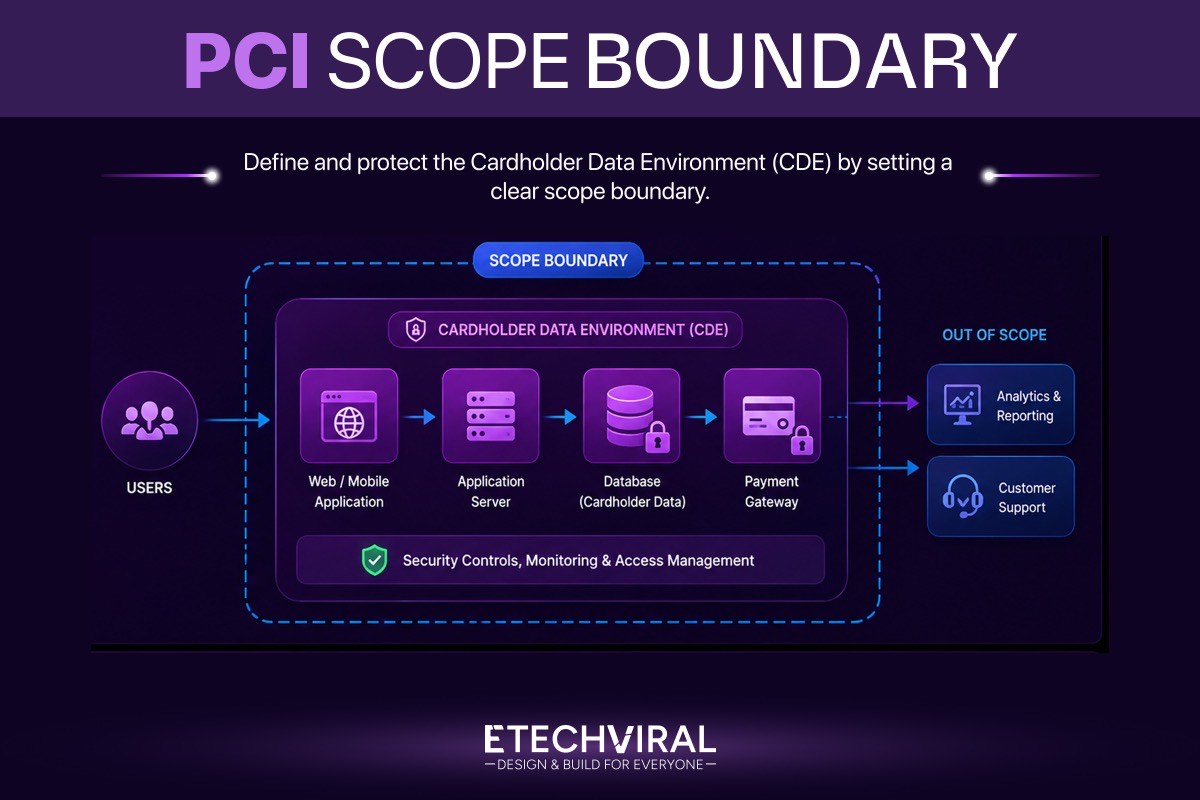
Diagram: what full PCI scope looks like when your own systems store cardholder data. Everything inside the boundary falls under PCI DSS, which is precisely the situation the next section shows you how to avoid.
In practice that means using a payment provider's own SDK or hosted fields so that the card number is captured by the provider and exchanged for a token. Your Flutter code sees a token, never the primary account number. That keeps your application in the reduced PCI scope that most product teams should be targeting, and it removes an entire category of risk from your codebase.
Concretely, the rules we apply on fintech builds are:
- Never log payment payloads. Not in debug builds, not in crash reports, not in analytics events.
- Never persist card data locally. Not even briefly, and not in an encrypted cache.
- Never build your own card input that posts raw PANs to your backend, which pulls your whole stack into PCI scope.
- Treat tokens as sensitive. A token is not a card number, but it still belongs in secure storage with a short lifetime.
If your product genuinely must handle card data directly, that is a different engineering programme with its own audit requirements, and it should be scoped deliberately rather than discovered late.
Architecting a Flutter Fintech App Around Money
Two mistakes cause most financial bugs in mobile apps, and both are avoidable at the architecture stage.
The first is representing money as a floating point number. Dart's double is binary floating point, so values such as 0.1 cannot be represented exactly and rounding errors accumulate across additions. Money should be held as an integer in minor units, for example cents, or as a decimal type, and the currency should travel with the amount rather than being implied. A value of 1050 means nothing until you know it is USD cents.
The second is putting financial rules in the UI. Fee calculations, limits, interest, and eligibility belong in the domain layer as pure Dart, where they can be tested exhaustively and reviewed in one place. This is the pattern set out in our Flutter Clean Architecture guide, and financial products are where it earns its keep: an auditor can read the use cases without reading a single widget.
A third rule is specific to payments: every state-changing financial operation needs an idempotency key. Mobile networks time out and retry, and users tap the confirm button twice. Without an idempotency key generated on the client and honoured by the server, a retry becomes a second transfer.
Securing Credentials and Tokens on the Device
Assume the device is hostile: it may be rooted, shared, or lost.
- Platform keystores only. Access and refresh tokens go in the iOS Keychain and the Android Keystore via
flutter_secure_storage. SharedPreferences is not storage for anything sensitive. - Biometric re-authentication. Use
local_authto gate re-entry and to confirm high-value actions such as transfers or adding a payee. - Short sessions and inactivity timeouts. Clear in-memory financial data when the app is backgrounded past a threshold.
- Certificate pinning for API traffic, so a compromised network cannot silently intercept requests.
- Root and jailbreak awareness. Decide the product's policy: warn, restrict certain actions, or block. Make it an explicit decision rather than an omission.
- Mask sensitive data in the app switcher and keep balances and account numbers out of push notification payloads.
KYC and AML Flows in a Flutter App
Know Your Customer and Anti-Money Laundering requirements shape onboarding more than any other factor. In most builds the verification itself is performed by a specialist provider, and the Flutter app's job is to present those steps well and to handle their outcomes.
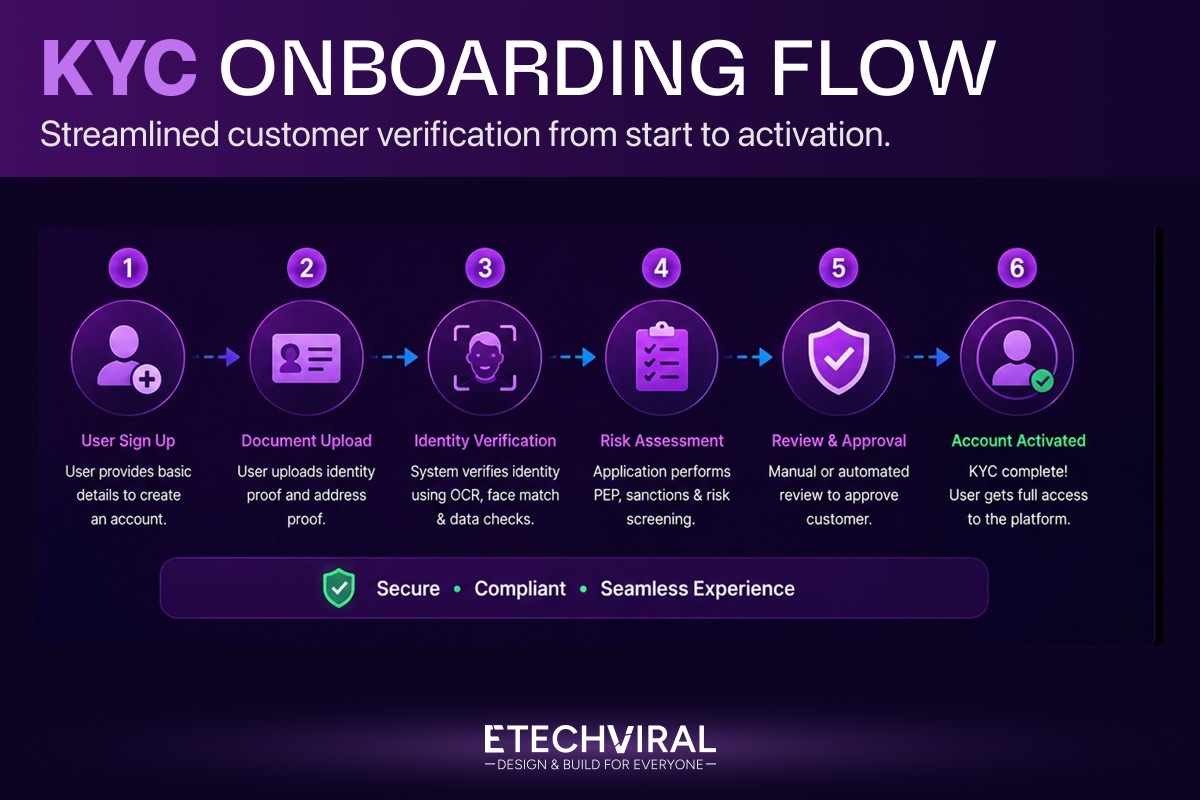
Diagram: a typical KYC onboarding sequence. Steps 3 to 5 are asynchronous, so the app needs a durable pending state and a way to resume.
The flows you will typically implement are identity document capture, a liveness or selfie check, address and identity data entry, and a waiting state while screening completes. That waiting state is the one teams underestimate: verification is asynchronous and can take minutes or hours, so the app needs a durable pending state, a way to resume, and clear messaging when a check is referred or fails.
From an architecture standpoint, treat the provider as an external system behind a repository interface. Providers get replaced, and you do not want their SDK's data shapes spread through your widgets.
Open Banking and Payment Integrations
Open banking lets a product read account and transaction data with the customer's consent, which underpins account aggregation, affordability checks, and payment initiation. Two things matter on the client side.
First, consent is a first-class flow, not a checkbox. The customer must understand what is being shared and for how long, and the app needs to show current consents and let them be withdrawn. Under PSD2, strong customer authentication also applies, which usually means a redirect or app-to-app handoff to the bank that your navigation must handle cleanly, including the return journey and failure cases.
Second, keep integrations behind your own API where practical. Aggregators and payment providers change contracts. If your Flutter app talks to your backend and your backend talks to them, a provider migration does not require an app release, which matters when app review can take days.
Testing and Releasing a Regulated Financial App
Financial logic is exactly the kind of code that unit tests were designed for, and a clean domain layer makes it straightforward.
- Unit-test the money rules exhaustively: rounding, currency conversion, fee tiers, limits, and boundary values. These run in milliseconds and are the tests a reviewer will want to see.
- Widget-test the confirmation and failure paths. Double submission, network loss mid-payment, expired session, and declined transaction are where real losses occur.
- Integration-test the critical journeys: onboarding with KYC, linking an account, and completing a payment.
Our Flutter testing guide covers how to write each layer. Releases should come from a pipeline, not a laptop, with signing keys held as secrets and every build traceable to a commit, which our Flutter CI/CD guide sets out with Fastlane and GitHub Actions. In a regulated environment that traceability is not a nicety; it is the evidence that what you tested is what you shipped.
Next Steps
Flutter gives fintech teams one codebase, one set of financial rules to review, and identical regulated flows on both platforms. The engineering discipline it demands is specific but well understood: keep card data out of your scope, represent money exactly, protect credentials with platform keystores, design consent and verification as real flows, and make releases reproducible.
If you are scoping a banking, payments, or lending product, our fintech app development team and our Flutter app development service can help you map the architecture and the compliance surface before code is written. You can also see the kinds of products we have delivered on our portfolio. Book a free consultation.
Frequently Asked Questions About Flutter for Fintech
Is Flutter secure enough for banking and fintech apps?
Yes, when it is built correctly. Flutter compiles to native code and gives you access to the same platform security primitives as a native app, including the iOS Keychain, the Android Keystore, and biometric authentication. Security in a fintech app comes from architecture and handling decisions rather than from the framework: keep card data out of scope, store credentials in the platform keystore, pin certificates, and never log sensitive payloads.
Does using Flutter make my app PCI DSS compliant?
No. PCI DSS applies to systems that store, process, or transmit cardholder data, regardless of the framework. The practical approach is to stay out of scope by using a payment provider's tokenising SDK, so the card number is captured by the provider and your Flutter code only ever handles a token. Building your own card input that sends raw card numbers to your backend pulls your entire stack into PCI scope.
How should money values be stored in a Flutter app?
Never as a double. Dart's double is binary floating point, so values like 0.1 are not represented exactly and rounding errors accumulate. Store money as an integer in minor units, such as cents, or use a decimal type, and always keep the currency code alongside the amount. Formatting for display should happen at the very edge of the app, not in the domain logic.
Can a Flutter app handle KYC and open banking flows?
Yes. KYC checks are normally performed by a specialist provider, with the Flutter app handling document capture, liveness checks, and the asynchronous pending state while screening completes. Open banking requires a proper consent flow and, under PSD2, strong customer authentication, which usually involves a redirect or app-to-app handoff to the bank. Both should sit behind repository interfaces so a provider change does not ripple through your UI.
What is the most common mistake in Flutter fintech apps?
Two dominate. The first is using floating point numbers for money, which produces rounding errors that are hard to trace once they accumulate. The second is missing idempotency on payment operations: mobile networks retry and users tap twice, so without an idempotency key generated on the client and honoured by the server, a single retry can become a duplicate transfer.